
- New catalyst makes zinc-air batteries rechargeable, solving technical hurdle.
- Rechargeable zinc-air batteries can achieve continuous runtime of 300 hours.
- Zinc-air batteries surpass lithium-ion batteries in cost and safety.
- Zinc-air batteries suited for stationary grid energy storage and heavy transport.
Chemists have unlocked a secret that could transform zinc-air batteries into the ultimate rechargeable energy source. Researchers at the Technical University of Darmstadt have developed a multifunctional composite material aimed at realizing rechargeable zinc-air battery technology. Making these batteries rechargeable has long been a formidable challenge, because controlling the complex chemical reactions inside the cell is the primary technical obstacle. To solve this problem, a research team led by Professor Jörg Schneider demonstrated a novel composite material composed of iron, nickel, and carbon that can stabilize these internal processes.
Notably, this development enables rechargeable zinc-air batteries to achieve a continuous runtime of 300 hours. The team stated: "The assembled secondary zinc-air battery can cycle for over 300 hours in constant-current charge-discharge testing."
Development of the new catalyst
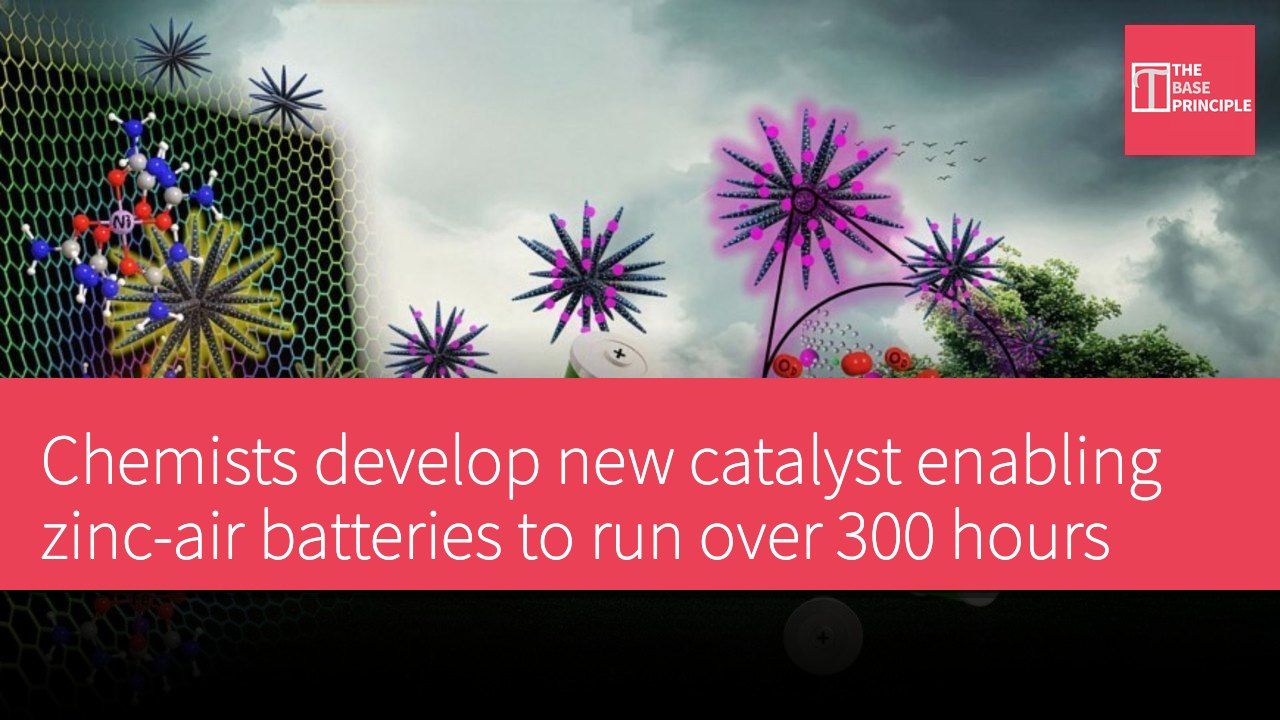
High-efficiency hybrid catalyst zinc-air batteries have long operated under the radar, primarily used in disposable products such as hearing aids. These batteries can store up to five times the energy of lithium-ion cells, but because controlling their complex internal chemistry during charging is nearly impossible, they have remained single-use. The research team solved this problem by firmly anchoring nanoscale spinel particles — composed of iron, nickel, and oxygen — onto a carbon material containing nitrogen and phosphorus. Spinels are widely used in materials science and electrical engineering for their unique properties. This new material leverages those specialized electrochemical characteristics to serve as a long-lasting internal catalyst.
Previously, nickel-iron oxide served as the base material for catalysts designed to drive the internal oxygen reactions in rechargeable zinc-air batteries. However, these catalysts faced challenges of low chemical activity and poor stability, limiting their application in rechargeable zinc-air batteries. To address this, researchers created a hybrid catalyst that encapsulates tiny nickel-iron oxide cubes within nitrogen- and phosphorus-doped carbon nano-corners. This carbon shell provides rapid electron and mass transport while creating numerous active reaction sites. The structure also protects the iron oxide particles from agglomeration or dissolution, making the catalyst more durable and effective.
This catalyst, a potential replacement for lithium batteries, demonstrated impressive electrochemical performance, with a half-wave potential of up to 0.79 V, a low Tafel slope of 56.5 mV/dec, and an efficient four-electron oxygen reduction pathway. When tested in a full zinc-air cell, it achieved a peak power density of 54 mW/cm², nearly double the 28 mW/cm² benchmark of standard platinum and platinum-catalyst setups. In laboratory testing, the catalyst enabled up to 300 hours of continuous operation by stabilizing the "triple junction" — the interaction of solid catalyst, liquid electrolyte, and ambient oxygen.
As a result, the material maintains the stable chemical conditions required for reliable long-term battery operation.
Advantages of zinc-air batteries
Zinc-air technology offers significant advantages over lithium-ion systems in cost, safety, and scalable applications. Lithium, cobalt, and nickel face severe supply-chain constraints, while materials such as zinc, iron, and carbon are globally abundant and economical. Moreover, zinc-air batteries use a water-based electrolyte that is non-flammable, eliminating the dangerous thermal-runaway fire risk associated with lithium-ion cells. Although their moderate power density makes them less suitable for fast-charging consumer electronics, their high energy density makes them ideal for stationary grid energy storage supporting solar and wind power. Ultimately, scaled-up zinc-air batteries could also serve as efficient long-range power sources for heavy transport and electric vehicles.
Item Specification Half-wave potential 0.79 V Tafel slope 56.5 mV/dec Peak power density 54 mW/cm² Benchmark power density 28 mW/cm² Continuous runtime 300 小時
Future potential of zinc-air batteries
Breakthroughs in zinc-air battery technology could change how renewable energy is stored. These batteries not only surpass lithium-ion cells in energy density, but also hold advantages in material availability and safety. As demand for sustainable energy grows, the application scope of zinc-air batteries may expand to stationary grids and heavy transport, which is crucial for the future energy transition. The researchers' innovative catalyst design enables long-term stable operation, which will further advance the commercialization of zinc-air batteries.