
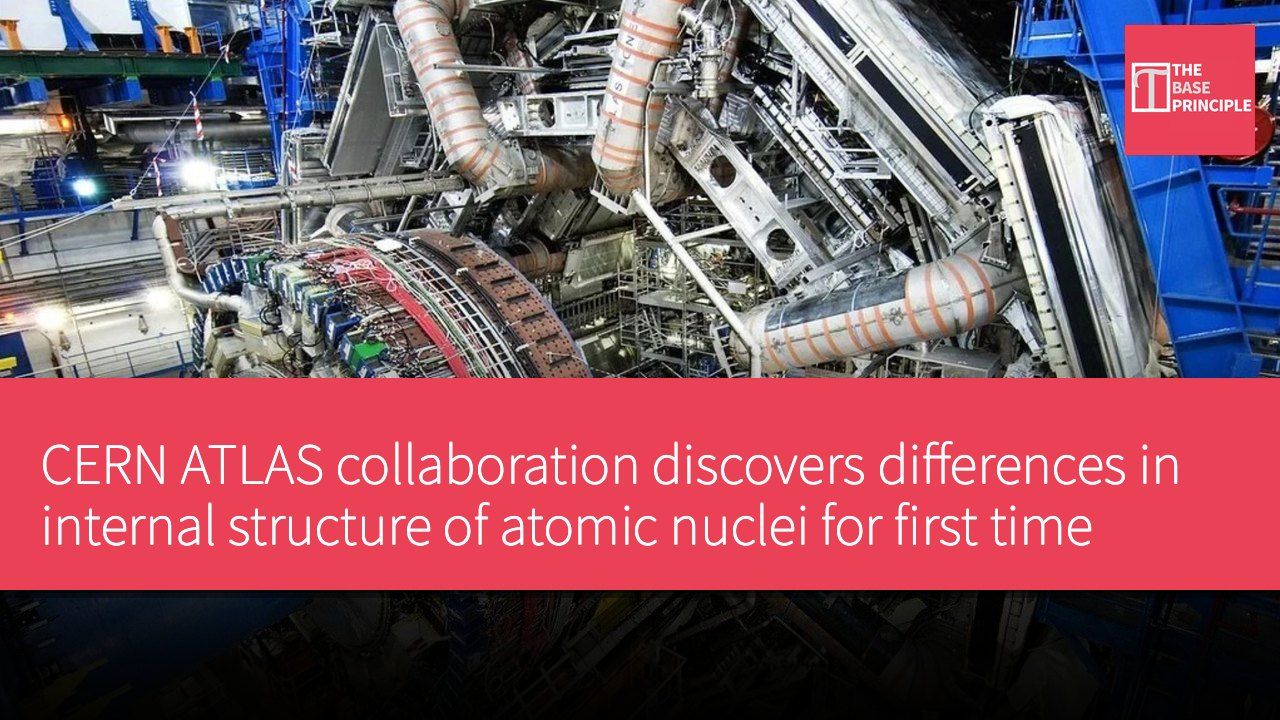
- ATLAS collaboration discovers internal structure differs between nucleons at nuclear edge and center.
- Quark and gluon momentum distributions inside nucleons change depending on position.
- Researchers unravel mystery of nuclear parton distribution functions through lead-ion collisions.
- Statistical tests show significant distribution differences between nucleons at nuclear edge and center.
Researchers from the ATLAS collaboration at CERN in Switzerland have uncovered the origin of an observation made more than 40 years ago. In analyzing data from experiments conducted in 2018, scientists found that nucleons at the edge of an atomic nucleus have a different internal structure than those at its center. For most people, the atom is the smallest and indivisible part of a chemical element. For nuclear physicists, however, the atom is the largest unit they typically consider, and a complex assembly of subatomic particles that goes beyond protons, neutrons and electrons, aimed at understanding the properties and behavior of these components.
Changes in internal structure of nucleons
Previous observations of nucleons — the protons and neutrons inside atomic nuclei — showed that the momentum distributions of quarks and gluons inside them also change depending on their position. This observation was first made in 1982 by the European Muon Collaboration (EMC), another experimental group at CERN. However, the cause of this observation remained elusive. Known as nuclear parton distribution functions (nuclear PDFs or nPDFs), the remarkable aspect is that the energy required to bind nucleons in a nucleus is negligible compared to the energy needed to resolve their internal structure.
Researchers from the ATLAS collaboration unraveled this mystery using ultra-peripheral lead-ion collisions. In these collisions, the ions do not meet head-on but pass close to each other without overlapping, interacting through their electromagnetic fields. In some collisions, a photon emitted by one nucleus strikes the other, producing narrow particle jets that allow further study of partons inside the nucleus. Typically these interactions shatter the nucleus and release 'forward' neutrons detectable by the ATLAS experiment's Zero Degree Calorimeter (ZDC). In a minority of these interactions, however, the photon may not break up the nucleus but merely strike a single nucleon, producing no 'forward' neutrons.
The researchers used data from lead-ion collisions conducted in 2018, with an integrated luminosity of 1.72 nb⁻¹.
Method for identifying nPDFs
How to identify nPDFs? To find the rare events where a photon strikes only a single nucleon, the researchers selected collisions that produced at least two jets but showed almost no additional activity in the ZDC. They then divided these collisions into two categories: those containing forward neutrons (labeled 0nXn) and peripheral collisions without forward neutrons (labeled 0n0n). In the inclusive collisions, the struck nucleon is likely located deeper inside the nucleus, while in peripheral collisions it is more likely at the nuclear edge. By measuring the observed jets, the researchers assigned proxy variables for the parton kinematics.
x+ is one such variable, helping estimate the fraction of the nucleon's momentum carried by the struck parton. By comparing the x+ distributions of the two event classes, the researchers sought to identify changes in the PDFs. They observed a distinct slope when comparing inclusive and peripheral collisions, indicating a difference in their nPDFs. To determine whether these differences were statistically significant, the team performed statistical tests confirming that nucleons at the nuclear edge have different parton distributions than those at the center, according to the press release.
How ATLAS research changes understanding of nuclear physics
The ATLAS collaboration's discovery has significant implications for nuclear physics because it challenges our fundamental understanding of the internal structure of atomic nuclei. Previous research focused mainly on the overall behavior of nucleons, while this study reveals the influence of position on the internal structure of nucleons, providing a new perspective for understanding interactions between nucleons. Moreover, the technical innovations of this research, particularly in the application of collision experiments, may open new directions for future nuclear physics research, promoting deeper exploration of subatomic particle behavior.