
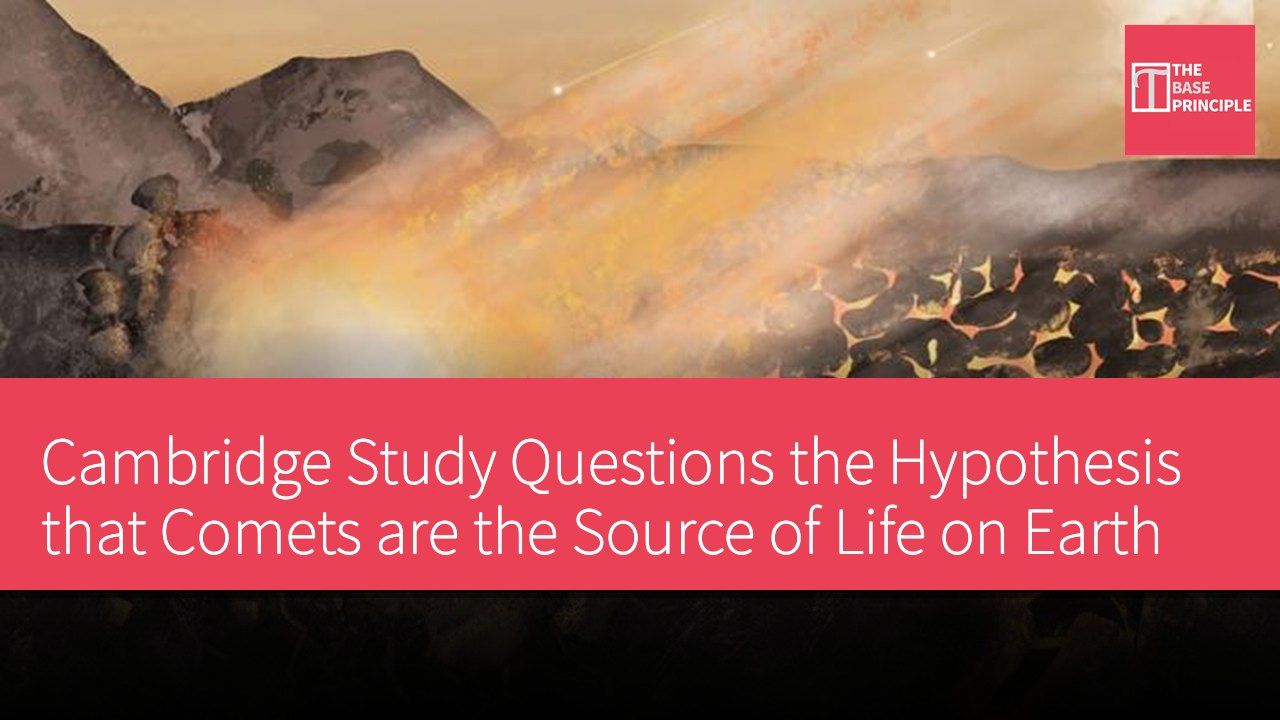
- The Cambridge study questions the role of comets as a source of life on Earth.
- Simulations show that organic molecules struggle to survive during comet impacts.
- Events involving the delivery of hydrogen cyanide are extremely rare and of short duration.
- Meteorite impacts and Earth's own processes may be alternative sources of life.
A new study led by the University of Cambridge challenges a century-old view that comets brought the molecular building blocks of life to Earth. Computer simulations indicate that the high impact velocity and steep collision angles of comets make it difficult for fragile organic molecules to survive. The delivery of comets is, at best, merely a "chance event," rather than the steady rain of prebiotic molecules previously theorized.
Comets have long been considered a pathway for delivering life's components because they carry carbon and nitrogen molecules. Lead author Dr. Richard Anslow from the University of Cambridge's Institute of Astronomy stated that this view is "somewhat romantic," but the research findings suggest that this possibility is "extremely unlikely." The team utilized recent advancements in simulating comet impacts, interactions with the atmosphere, and the origins and evolution of comets. Their simulations indicate that these molecules would almost certainly vaporize upon impact with the Earth's surface.
The Hypothesis of Comets as Life Component Deliverers
This study builds on research proposed by Anslow and several co-authors in 2023, which suggested that comets might slow down by "bouncing" between planets in close orbits. These bouncing comets could potentially deliver organic molecules during their journey. The new paper examined whether this scenario could occur in the solar system and found that it is extremely rare.
The researchers focused on hydrogen cyanide (HCN), an important prebiotic molecule commonly found in solar system comets. Even in the rare instances where hydrogen cyanide might survive an impact on Earth, the events delivering useful concentrations are exceedingly rare. During the first 500 million years of a planet's existence, the number of comets impacting Earth rapidly declines, with at most only a few opportunities for hydrogen cyanide delivery. Even if hydrogen cyanide reaches the surface, its concentration would not last long, necessitating rapid prebiotic chemistry after the impact.
Other Possible Sources of Life
Anslow noted that this requires a "one in a million chance," needing the correct impact speed and angle, along with subsequent rapid favorable chemical reactions. He pointed out that while this scenario cannot be entirely ruled out, it appears to be "at best merely a chance event." If comets did not spread life, other sources still exist. The researchers indicated that molecules synthesized from meteorite impacts are another possible source, as the frequency of meteorite impacts on Earth is much higher than that of comets.
Another possibility is that chemical precursors formed through Earth's own processes without external assistance. Mars may be a slightly better candidate for comet delivery, although it remains highly unlikely. Mars is smaller than Earth and currently has a thinner atmosphere, making it more likely for comets to reach its surface during frequent visits. Anslow stated that this does not imply that it has occurred on Mars. He noted that if it is unlikely to happen on Earth, it is also unlikely to happen on Mars, adding that a more plausible alternative is that neither planet experienced such events.
These findings may assist in the search for life elsewhere, particularly after the deployment of successors to the James Webb Space Telescope, such as the proposed Habitable Worlds Observatory. Identifying systems capable of comet bouncing could be a method for astronomers to narrow their search. The research results have been published in the journal Scientific Reports.
Reassessing the Connection Between Comets and the Origin of Life
This study challenges the long-held view that comets are a significant source of molecular life on Earth. Through simulations, the research shows that the impact characteristics of comets make it difficult for organic molecules to survive on Earth, suggesting that the origin of life may not rely as heavily on comets as previously thought. Meteorites and Earth's own chemical processes are proposed as more likely sources of life, which not only alters our understanding of life's origins but may also influence future strategies for searching for life on other planets.