
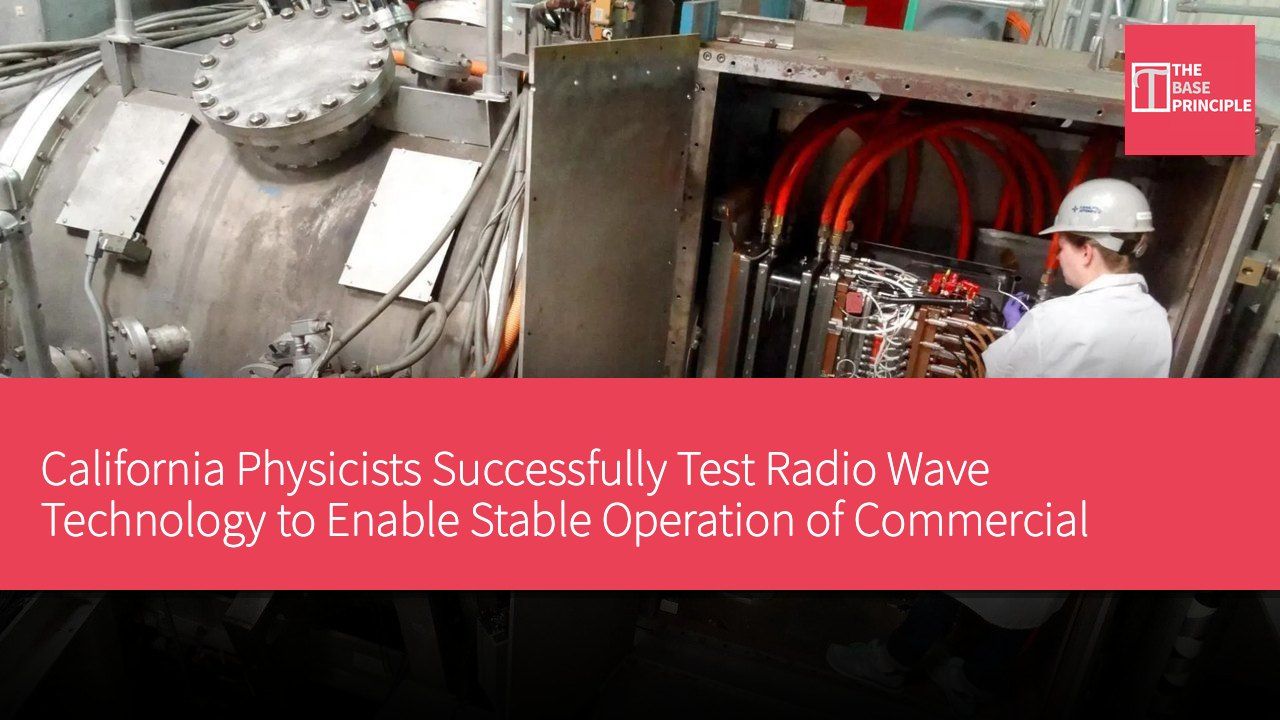
- California physicists successfully tested radio wave technology to facilitate the operation of commercial fusion power plants.
- Helical current drive was successfully tested for the first time in high-temperature fusion plasma.
- This technology provides an effective energy delivery solution, overcoming bottlenecks in existing systems.
- Modern engineering techniques have made it possible to replicate conditions close to those in a reactor.
Physicists in California have validated a radio wave technology that promises to enable round-the-clock operation of commercial fusion power plants. According to results published in Physical Review Letters, this marks the first successful test of "helical current drive" in high-temperature fusion plasma. Researchers at the DIII-D National Fusion Facility used specially designed antennas to directly emit high-frequency radio waves into the ionized gas, generating internal currents to maintain stability in the reaction. The researchers stated in a new study: "Helical current drive is an attractive solution for driving current under reactor conditions to maintain steady-state tokamak operation."
They noted, "Dedicated DIII-D experiments have successfully demonstrated core energy deposition and current drive via helical waves emitted through traveling wave antennas at MW levels."
Technological Breakthrough of Helical Current Drive
This milestone comes as global developers face bottlenecks in competitive designs. Tokamaks in China and France employ a method known as low hybrid drive. However, this system fails when fuel density reaches commercial levels. The planned STEP plant in the UK has opted for microwave beams as an alternative. While easier to install, these microwave beams consume too much energy to be commercially viable. Helical waves offer a compromise, effectively delivering energy deep into the fuel. Nevertheless, this concept had nearly faded from history.
Physicists first experimented with this mechanism in the 1980s, labeling it "fast wave drive," but each attempt ended in failure. Mathematical models explain that these waves would pass through the fuel unless the plasma reached enormous, reactor-level temperatures and pressures. Lacking such machines, the fusion community shelved the idea for decades.
Support from Modern Engineering Techniques
Modern engineering techniques have finally caught up with the theory. The contemporary hardware at the DIII-D facility enables engineers to replicate conditions close to those in a reactor. They combined this with advanced "composite" antennas that emit radio signals at precise angles within a magnetic field. High-precision instruments confirmed that the fuel absorbed this beam, generating target currents deep in the plasma core. Finding alternative current sources is crucial for fusion to supply power to the grid. Most test reactors use massive magnetic coils located at the center to drive currents. This magnetic coil acts like a giant transformer; however, the transformer must continually change the magnetic field to generate power, which inevitably drains charging capacity, causing the reactor to stop and reset every few minutes.
The constant cycle between burning heat and sudden cooling severely fatigues the reactor walls.
A natural phenomenon known as guiding current provides partial support for this flow. Nevertheless, the fuel in the mid-radius region still requires external support. Helical drive provides this missing link, although substantial engineering work remains. Recent experiments have validated core physics at moderate power levels and low confinement modes. Engineers now need to build more powerful wave generators to demonstrate that the system can maintain stability during full-power operation. If successful, this will transform pulsed fusion prototypes into steady-state power plants.
Potential Impact of Helical Current Drive
The successful testing of helical current drive technology marks a significant advancement for commercial fusion energy. As global demand for clean energy increases, the stable operation of fusion energy becomes crucial. This technology not only overcomes previous bottlenecks but also offers new possibilities for future fusion power plants. With advancements in engineering technology, this breakthrough is expected to push fusion energy toward commercialization, potentially having a profound impact on the global energy market.