
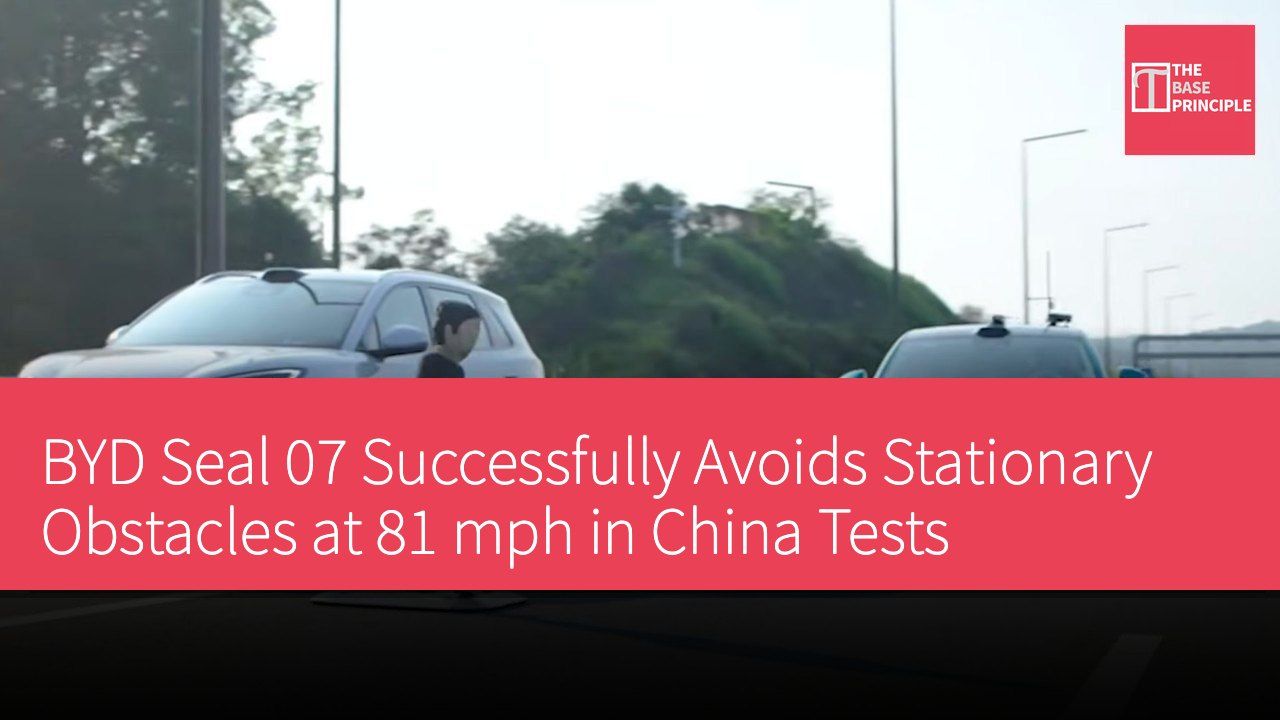
- BYD Seal 07 successfully avoided a stationary obstacle during testing.
- The God’s Eye B system can perform emergency driving assistance at high speeds.
- The driver disengaged from the steering wheel during the test, with the system operating automatically.
- BYD plans to introduce the God’s Eye system to overseas markets.
The BYD Seal 07 sedan successfully navigated around a stationary simulated vehicle at 81 mph during a test in China, showcasing the emergency capabilities of the automaker's God’s Eye B driving assistance system. As an SUV moved aside, the vehicle issued a warning and changed lanes, revealing the obstacle. This high-speed test was one of three planned for BYD's second-generation sedan. In two additional tests conducted at 56 mph, the Seal 07 maneuvered around a stationary target and avoided a child dummy that appeared from behind parked vehicles.
In the first test, a BYD Sealion 05 SUV guided the Seal 07 toward a stationary target. As the SUV approached the simulated vehicle, it changed lanes, allowing the sedan to gradually approach the obstacle. Footage from the test shows the Seal 07's driver disengaged from the steering wheel before the vehicle maneuvered around the target. A warning appeared on the dashboard, and the sedan activated its hazard lights. The footage ended shortly after the Seal 07 passed the simulated vehicle, making it unclear whether the sedan returned to its original lane. This test speed exceeded the typical speed limit of approximately 75 mph (120 km/h) on highways in mainland China.
Driving Assistance System in Testing
In the second test, BYD added a truck, positioning the Seal 07 between it and the Sealion 05. Similar to the first test, the SUV moved aside to expose the stationary target. The sedan changed lanes to avoid the obstacle, while the truck followed closely behind. The truck's sudden braking posed an additional risk for the Seal 07. The abrupt deceleration could have put the Seal 07 at risk of a rear-end collision, demonstrating how the system navigated around obstacles in this scenario. The third test was also conducted at 56 mph, this time featuring a moving target.
As the sedan approached, a child dummy appeared from behind parked vehicles. The driving assistance system detected the dummy and maneuvered the vehicle out of its path.
Overview of the God’s Eye B System Technology
The God’s Eye B system is powered by a radar sensor mounted on the roof, 12 cameras, 12 ultrasonic sensors, and five millimeter-wave radars. These sensors transmit data to a single Nvidia Drive Orin X chip, which can process up to 254 trillion operations per second. God’s Eye B supports emergency braking, emergency steering, and automatic parking, and provides autonomous driving navigation capabilities, allowing the vehicle to navigate from one address to another under driver supervision.
BYD plans to launch the second-generation Seal 07 in China in November 2026, offering both battery electric and plug-in hybrid versions. The all-electric model has a rated range of up to 775 kilometers under the China CLTC testing cycle. BYD states that the vehicle can charge from 10% to 97% in just 9 minutes. The automaker plans to introduce the God’s Eye system to overseas markets. The Denza Z9 GT wagon is expected to be the first BYD vehicle to offer the system's urban navigation assistance feature in Europe.
Item Specification Drive System Nvidia Drive Orin X Number of Sensors 12 cameras, 12 ultrasonic sensors, 5 millimeter-wave radars Range 775 kilometers
Future Potential of BYD's Autonomous Driving Technology
The successful testing of the BYD Seal 07 demonstrates the reliability of its advanced driving assistance system in emergency situations. The system not only effectively avoids obstacles at high speeds but also highlights advancements in autonomous driving technology. As BYD plans to introduce this technology to overseas markets, it could impact the competitive landscape of the global electric vehicle market and encourage other manufacturers to develop their own autonomous driving capabilities.