
- X-ray experiments at Brookhaven National Laboratory have begun to automate, with data volume reduced to one-tenth of the usual amount.
- Automated experiments can run for hours without human intervention, focusing on scientifically important locations.
- The team collaborates with NVIDIA to reconstruct images in real-time, achieving a speed of 200 images per second.
- This technology aids in rapid, high-resolution X-ray imaging, applicable to microelectronics and nanomaterials research.
X-ray experiments at Brookhaven National Laboratory have begun to automate. Machine learning technology selects areas within samples that require detailed examination and reconstructs 3D images as data arrives, with the amount of data needed in one test being only one-tenth of what is usually required. These demonstrations were conducted at the National Synchrotron Light Source II (NSLS-II), a user facility of the U.S. Department of Energy, as part of the SYNAPS-I project, which stands for Synergistic Neutron and Photon Science – Intelligent. This project is a seed initiative under the Department of Energy's Genesis mission, led by the Advanced Light Source at Lawrence Berkeley National Laboratory, in collaboration with the Argentine National Laboratory, Oak Ridge National Laboratory, SLAC, and Brookhaven.
The collaborative project combines open-source models, industry partnerships, and advanced computational resources.
Advantages of Automated Experiments
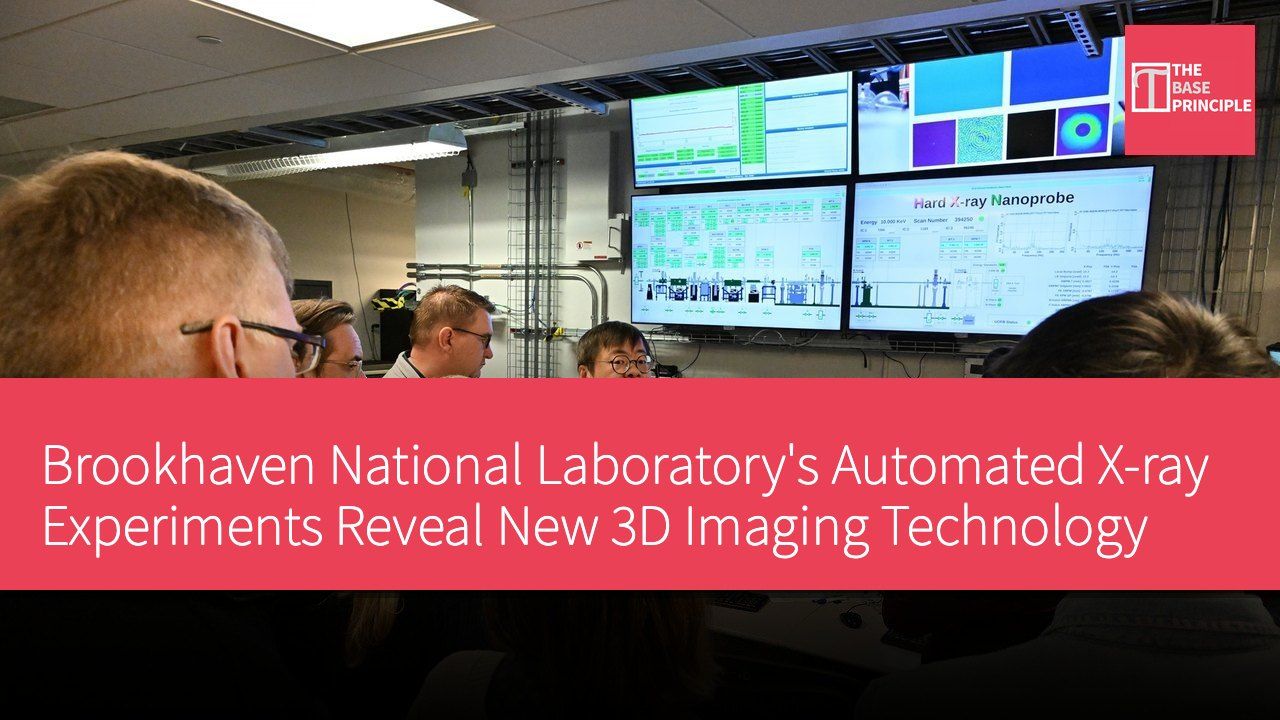
At NSLS-II's hard X-ray nanoprobe, a type of X-ray microscope used for 2D and 3D nanoscale imaging, a team led by chief beamline scientist Hanfei Yan conducted an automated experiment to analyze the acquired images. The system marked scientifically interesting regions within complex samples and selected these locations for subsequent high-resolution scans without human intervention. "This allows automated experiments to run for hours, investigating larger areas and collecting high-fidelity data only from scientifically important locations," said Daniel Allen, head of the NSLS-II data engineering team.
He noted that traditional methods cannot reliably achieve this.
Applications of Real-Time Reconstruction Technology
The second test focused on phase diffraction imaging, a computational technique that constructs detailed 3D images through multiple individual measurements, using microelectronic chips as samples. A foundational model trained at the Argentine National Laboratory replaced the slow iterative process typically used for image reconstruction. The team collaborated with NVIDIA and its Holoscan platform to reconstruct images in real-time, achieving a speed of 200 images per second. A model developed and trained at NSLS-II was able to reconstruct microchips using only one-tenth of the usual data required, which helps in handling thin and flat samples, as complete tomographic datasets are difficult to collect.
Subsequently, the team fine-tuned Meta's open-weight Segment Anything Model 3 to automatically identify regions of interest within materials, structures, and 3D volumes. These steps can shorten scan times and radiation doses while accelerating interpretation speed.
Hanfei Yan stated that this technology can assist any field requiring rapid, high-resolution X-ray tomography and fast 3D data analysis. Examples include searching for buried structures and defects in microelectronics, studying the degradation of battery electrodes, and characterizing complex nanomaterials. He noted that these tools also help users make better use of limited beam time.
Future Directions
The team plans to train more robust foundational models on more diverse datasets and extend this approach to other 3D imaging technologies. Their primary goal is real-time tomography. Currently, researchers typically collect the entire projection dataset before reconstruction. In a real-time workflow, reconstruction will begin at the start of the experiment, with low-resolution images continuously clarified as more measurement data arrives. Coupled with automated feature detection, this will allow beamlines to self-adjust based on their observations. Sean McSweeney, acting deputy director of strategy at NSLS-II, stated that such workflows will be central to next-generation user facilities.
Alexander Heckmayer, contact for the SYNAPS-I project, noted that facilities face the same challenges, including data volumes exceeding human analysis speeds and reconstruction bottlenecks, with no single facility able to solve these issues alone. As these technologies mature, the goal is not only to process experimental data faster but also to strengthen the connections between measurement, analysis, and scientific decision-making, allowing experiments to respond to their findings in real-time.
Potential of Automated X-ray Imaging Technology
The automated X-ray experiments at Brookhaven National Laboratory mark a significant advancement in scientific research. This technology not only significantly reduces the amount of data required but also enhances imaging efficiency, which is particularly important for research in microelectronics and nanomaterials. As the technology matures, researchers will be able to acquire and analyze data more quickly, facilitating immediate responses in scientific decision-making. Furthermore, the development of this automated process could become central to future user facilities, providing stronger support for various scientific research endeavors.