
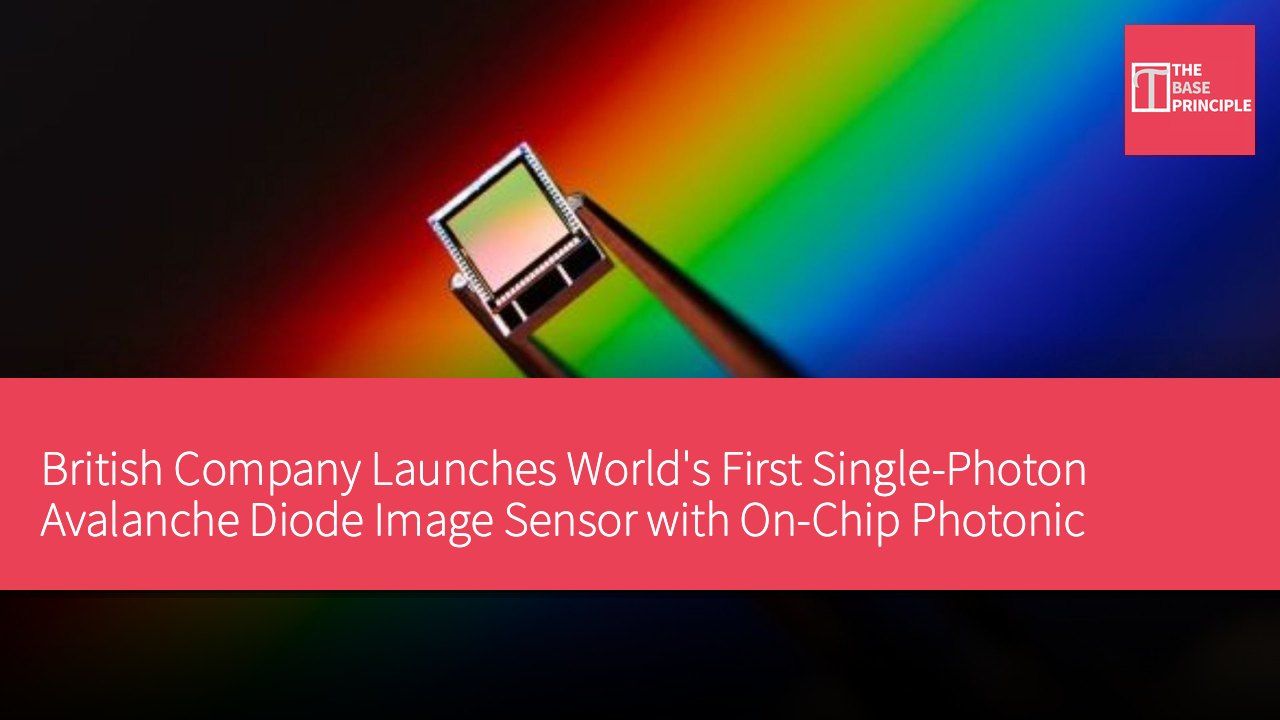
- Litavis is the world's first single-photon avalanche diode sensor with in-pixel processing capabilities.
- The sensor reduces data transmission needs, enabling lower latency and more efficient imaging systems.
- Litavis supports multiple operating modes, capturing photon arrival times and event distribution information.
- The sensor's flexibility makes it suitable for various fields, including machine vision and quantum technology.
Edinburgh-based semiconductor company Singular Photonics has launched Litavis, a new image sensor designed to integrate photon counting, time measurement, and statistical analysis directly onto a single chip. The company describes Litavis as the world's first single-photon avalanche diode (SPAD) sensor with in-pixel processing capabilities, capable of combining imaging, time measurement, histogram generation, and photon statistics within the same device. Litavis no longer sends large amounts of raw photon data to an external processor; instead, it performs some analysis internally within the sensor.
Singular Photonics states that this reduces data transmission needs and enables lower latency and more efficient imaging systems.
The Sensor's Versatile Operating Modes
SPADs are designed to detect single photons and are particularly useful in extremely low-light conditions or for precise measurement of photon arrival times. Building on this sensitivity, Litavis achieves software-configurable operation of the sensor. The same hardware can be reconfigured for different imaging tasks without redesigning the sensor. Its operating modes include photon-counting imaging, programmable time gating, different time-to-digital converter (TDC) configurations, time-correlated single-photon counting (TCSPC), coincidence detection, and the ability to combine time stamps with imaging. This allows the sensor to not only capture how much light each pixel receives but also to obtain information about when the photons arrive and how events are distributed over time.
This additional information can help in situations where traditional intensity-based imaging is insufficient.
Litavis uses a CMOS SPAD structure and directly integrates digital photon processing within the pixel array. The sensor provides continuous 256 × 256 pixel photon-counting imaging in low-light conditions. At the same time, it can generate time-stamped photon events on a 64 × 64 macropixel grid, offering picosecond-level time precision and generating this concurrently with the full-resolution photon-counting image. The device also supports multi-event timing, allowing multiple photons detected within an excitation cycle to be assigned to time bins. Its built-in histogram generation capability can be used to analyze the statistical distribution of these photon events.
According to Singular Photonics, this opens up new possibilities beyond traditional camera imaging, including applications in fluorescence lifetime imaging, dynamic light scattering, and quantum sensing.
The Advantages of Reducing Data Transmission
This approach also addresses a practical issue that may become significant as imaging systems collect more data. Litavis does not need to transmit every detected photon event to another processor for analysis; some processing is done internally within the sensor. Singular Photonics states that this can reduce the amount of raw data that needs to be transferred within the system, potentially improving latency and energy efficiency while making real-time processing more effectively scalable.
The Potential for Flexible Applications
The company positions Litavis as a flexible platform rather than a sensor targeted at a specific application. Potential uses include machine vision, robotics, physical AI, depth sensing, spectroscopy, scientific and medical imaging, quantum technology, and industrial automation. Its software-configurable architecture is designed to allow developers and system integrators to use the same hardware to experiment with different data acquisition and timing modes. This could reduce the need to develop separate sensor architectures for different applications and shorten development cycles.
Singular Photonics CEO Shahida Imani said, "Litavis combines the sensitivity advantages of SPAD technology with the adaptability and scalability increasingly required by modern multimodal imaging." The company states that it has received substantial pre-orders from international companies and institutions. The company plans to demonstrate Litavis at the SPIE Sensors + Imaging exhibition in Edinburgh and further showcase it at the VISION exhibition in Stuttgart, giving developers the opportunity to see the sensor's multimodal capabilities in action.
Litavis attempts to shift some intelligence into the sensor itself, rather than viewing the image sensor simply as a device that captures photons and leaves all interpretation to the computer.
The Impact of Litavis on Image Sensing Technology
The launch of Litavis marks a significant advancement in image sensing technology, particularly for applications in low-light environments. Its internal photon processing capabilities not only improve imaging efficiency but also reduce reliance on external processors, which is crucial for applications requiring real-time data processing. As technology continues to evolve, this flexible sensor design could change the traditional development model of image sensors and foster innovation across various industries, especially in areas like machine vision and quantum technology.