
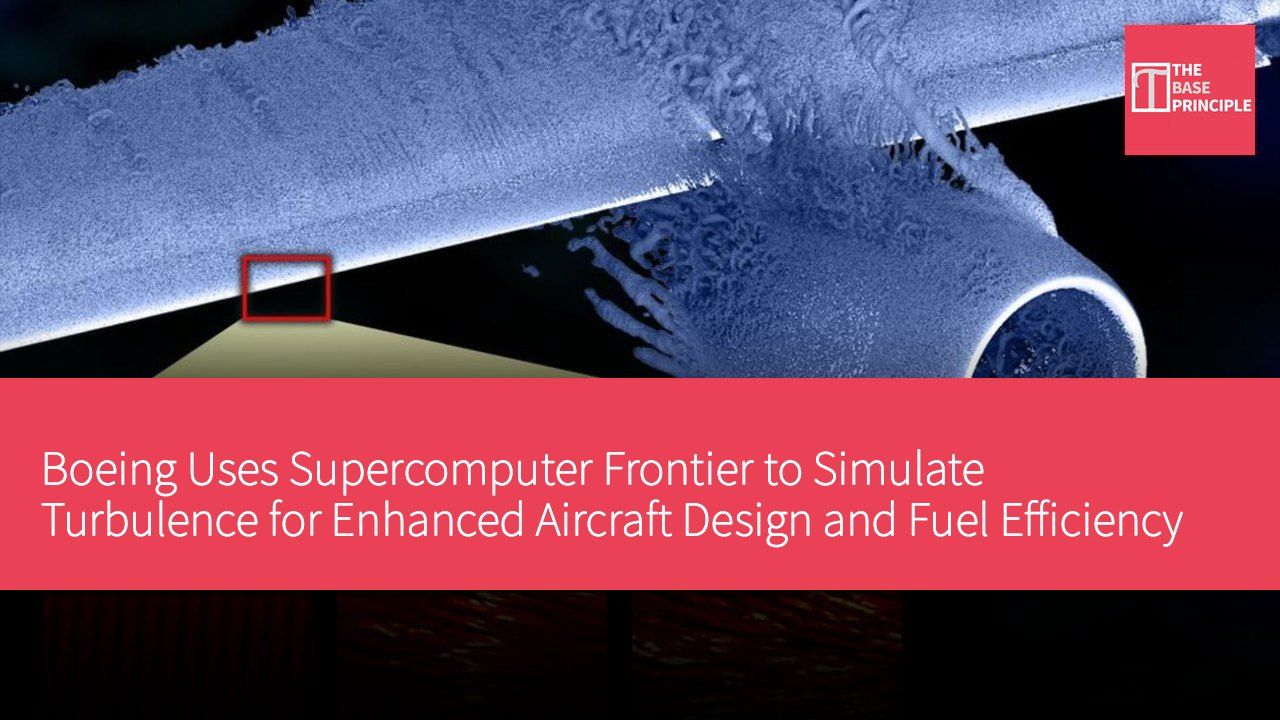
- Boeing uses the supercomputer Frontier to simulate turbulence for improved aircraft design.
- Minor aerodynamic improvements can significantly reduce fuel consumption.
- Predicting turbulence remains a major challenge in fluid dynamics.
- High-precision models give engineers more confidence to move designs into production.
Designing a safer, faster, and more fuel-efficient aircraft relies on understanding one of the most difficult problems in physics: turbulence, or chaotic airflow. To address this challenge, Boeing researchers are using the Department of Energy's Oak Ridge National Laboratory (ORNL) first supercomputer, Frontier, to simulate how ice accumulation and microscopic turbulence affect aircraft performance during critical flight phases, such as landing. These simulations are expected to assist engineers in improving aircraft design, clarifying puzzling results from wind tunnel experiments, and accelerating the development of more fuel-efficient aircraft.
Even minor aerodynamic improvements can lead to substantial differences. According to research from airlines, reducing aerodynamic drag by just 1% during cruise flight can lower fuel consumption by 0.75%, thereby reducing operational costs for airlines and potentially lowering ticket prices.
The Challenges and Impacts of Turbulence
Turbulence remains one of the most challenging problems in physics. The airflow around an aircraft constantly switches between smooth, orderly motion and chaotic turbulence. Accurately predicting when and how this transition occurs is still one of the biggest unresolved challenges in fluid dynamics. The difficulty lies in the interactions of a vast number of air molecules near the aircraft's surface. Researchers have long focused on the boundary layer, the thin layer of airflow closest to the wings, where small changes in airflow determine the drag experienced by the aircraft. Capturing these interactions requires simulations of airflow at nearly microscopic scales.
However, the more details engineers incorporate, the higher the computational demands become.
The aerodynamics of aircraft are typically studied through wind tunnel tests, flight testing, and computational fluid dynamics (CFD) simulations. Wind tunnel testing and flight experiments provide valuable data but are costly and time-consuming. CFD offers a faster alternative by dividing the aircraft into a digital grid containing millions of tiny cells, some just a few millimeters in size. The software calculates the airflow characteristics for each cell, including pressure, velocity, and temperature, and then combines them into a complete picture of the airflow around the aircraft. Most engineers rely on Reynolds-averaged Navier-Stokes (RANS) simulations, which estimate turbulence rather than calculating every single vortex in the airflow.
This method is fast enough for full aircraft simulations but cannot accurately capture rapidly changing turbulence.
The Contribution of Supercomputer Frontier
Higher-precision methods provide greater accuracy but require immense computational power. This is where Frontier comes into play. The supercomputer can perform 2 quintillion calculations per second, allowing Boeing to run simulations that would take months to complete on traditional industrial systems. Researchers are using this system to study the effects of different ice shapes and textures on wing performance and to simulate turbulence with more detail than ever before. These simulations also help evaluate the aircraft's de-icing systems and explain previously unexplained wind tunnel observations.
According to Boeing, these high-precision models predict an error in the aircraft's lift coefficient of only 1%, giving engineers more confidence to move promising designs into production. The team believes these findings will benefit the broader aerospace industry, as these simulation methods are based on a well-researched aircraft model that other researchers can build upon to improve future aircraft designs.
The Importance of Supercomputers in Aircraft Design
Boeing's use of the Frontier supercomputer for turbulence simulations highlights the critical role of efficient computing in aircraft design. The complexity of turbulence makes accurate predictions challenging with traditional methods, limiting improvements in aircraft performance. Frontier's computational power enables researchers to conduct more refined simulations, thereby enhancing aircraft design and fuel efficiency. This not only helps reduce operational costs for airlines but may also influence the development of future aviation technologies, advancing the entire industry.