
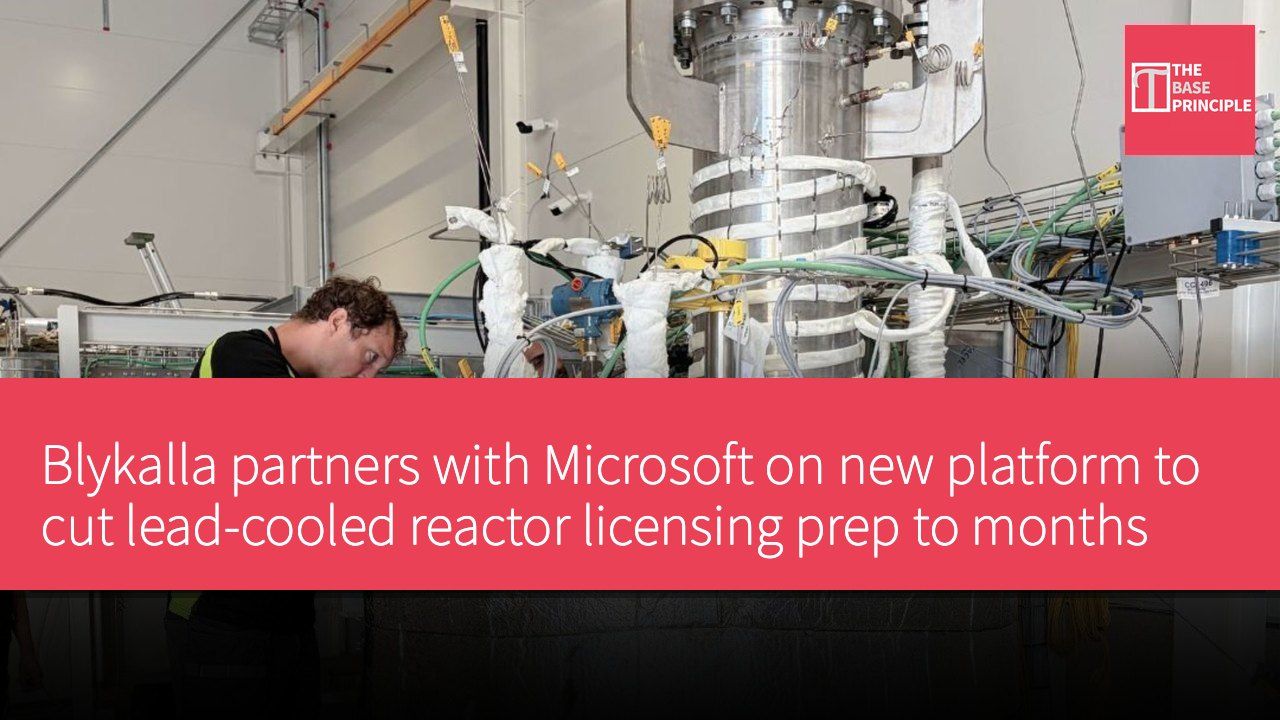
- Blykalla partners with Microsoft on a new platform to shorten licensing preparation time.
- The platform automatically evaluates data against regulatory standards, cutting documentation time and resources.
- Blykalla's SEALER reactor uses molten lead as a coolant, addressing metallurgical challenges.
- A patented aluminum-alloyed steel resists corrosion from liquid lead, advancing commercialization.
Nuclear technology company Blykalla has deployed a new computing platform developed with Microsoft to clear the licensing and regulatory hurdles for its lead-cooled reactors. The system automatically evaluates reactor data to meet stringent regulatory standards. By converting complex test datasets directly into compliant technical dossiers, the company aims to reduce licensing preparation cycles from years to months. The software platform supports active licensing applications in two countries. In Sweden, Blykalla is advancing plans to build two advanced reactor parks. In the United States, the company is using the platform to process technical files for pre-application discussions with the Nuclear Regulatory Commission.
Operating in English and Swedish, the digital system is designed to cut documentation time and resources by 90% without lowering nuclear safety standards. Blykalla's head of AI, Jon Christensen, said: "Our shared goal with Microsoft is to compress licensing-documentation preparation from years to months, cut time and resources by 90%, and uphold the rigor regulators require."
Capabilities and goals of the new platform
Against that metallurgical backdrop, the actual reactor behind this computational workflow is a Swedish advanced lead reactor called SEALER. Unlike conventional commercial reactors that rely on light water, SEALER uses molten lead as a coolant. Lead-cooled reactors are not new; they were first deployed in the 1960s. But there is a metallurgical problem. At sustained high temperatures, liquid lead leaches essential elements—particularly iron and nickel—out of standard stainless steel. Over time, this chemical leaching inevitably weakens critical reactor components and structural walls.
Blykalla has addressed this long-standing degradation mechanism with a patented material innovation: steel alloyed with aluminum. Under high-temperature reactor conditions, aluminum forms a stable protective boundary on the steel surface. This barrier prevents molten lead from stripping away iron and nickel.
Patented material innovation tackles metallurgical challenges
Blykalla's advanced modular reactor (AMR) leverages the company's breakthrough material innovation—a proprietary and patented aluminum-alloyed steel resistant to the corrosive nature of liquid lead—to commercialize lead-cooled fast reactors. The molten lead's high boiling point and low operating pressure also eliminate the need for large, high-pressure containment vessels. As a result, SEALER is compact and modular. These small modular units can be built off-site and shipped directly to where energy is needed, avoiding the need for long-distance power transmission. The self-contained cooling arrangement allows reactors to be sited next to large industrial operations and to large data centers with steady, around-the-clock power demand.
Plans to adapt to North American infrastructure
To ready the hardware for North American infrastructure, Blykalla recently launched an engineering facility on Barton Springs Road in Austin, Texas. The Austin engineering team is responsible for adapting the lead-cooled system to U.S. utility networks and industrial standards. Running in parallel with these physical design efforts, the software tools developed with Microsoft convert engineering documentation, test data and safety analyses into regulatory files that meet European and U.S. authority requirements.
Future potential of Blykalla's reactor technology
Blykalla's lead-cooled reactor technology points to a new direction in nuclear development, particularly in safety and efficiency. Through its partnership with Microsoft, the company is not only accelerating the licensing process but also using advanced materials technology to tackle metallurgical challenges in traditional reactors. These innovations could improve the viability of nuclear power and promote its commercialization in industrial applications, especially in high-demand settings such as data centers. With infrastructure adaptation underway, Blykalla's technology has the potential to play a significant role in the global energy market.