
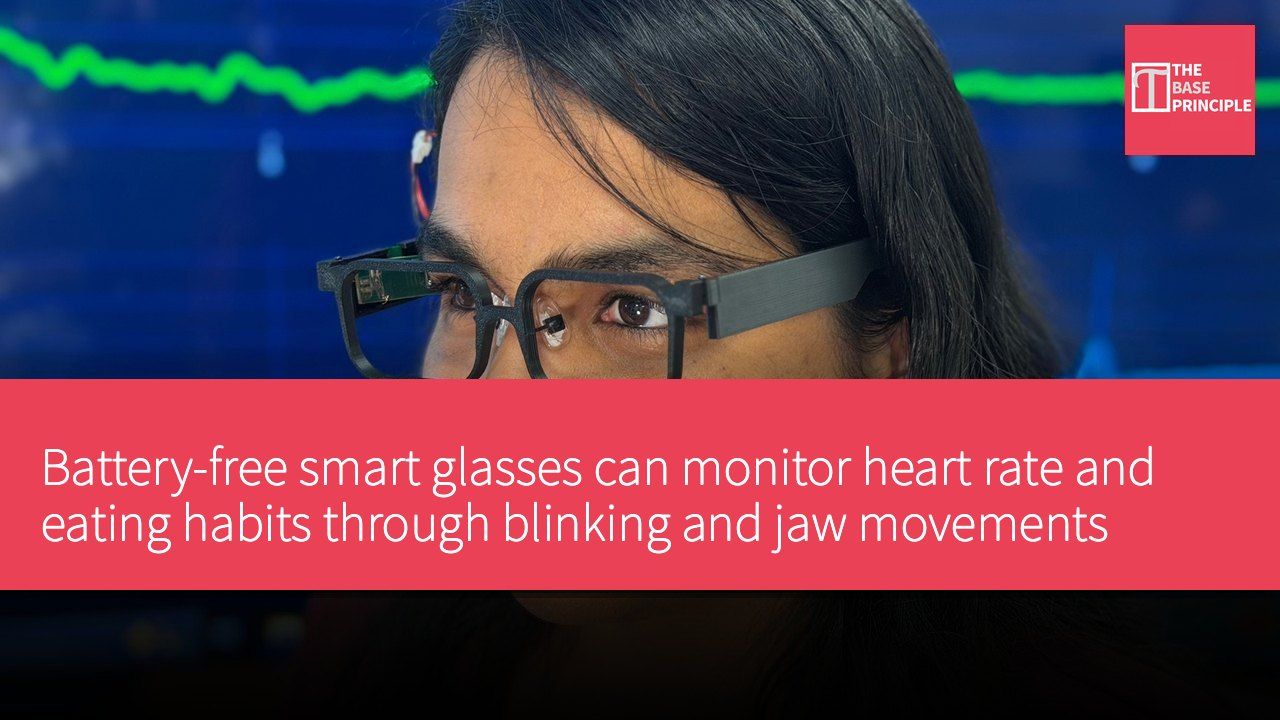
- GlassTENG glasses require no battery, generating power from facial movements.
- Three ultra-thin triboelectric nanogenerators drive sensors to collect data.
- Machine learning algorithms analyze movements, achieving 93.8% accuracy.
- This technology can monitor cardiovascular health and eating habits.
Everyday glasses may soon track heart activity, biting, and eating habits via sensors without batteries, according to a study by Northwestern University engineers. The prototype, called GlassTENG, uses sensors to harvest mechanical energy from facial movements and convert it into the electricity needed for detection. Nivedita Arora of Northwestern's McCormick School of Engineering, who participated in the research, said the goal is to turn glasses into health wearables without changing people's habits, since roughly half the population already wears glasses.
The design centers on three ultra-thin triboelectric nanogenerators. They rely on the triboelectric effect: when two different materials contact and separate, electrons move between them, creating a transient charge. Each flexible sensor contains a multilayer structure that repeatedly presses together and pulls apart with facial movements. Rapid blinking, jaw clenching, or blood flowing through arteries can all drive these sensors. Arora said the act of blinking helps power the sensor that detects blinking.
Sensor design and function
The team placed one sensor on the nose bridge, near the angular artery and periorbital muscles, to detect pulse, blinking, and eyebrow movements. A second sensor sits near the temple, over the superficial temporal artery, detecting pulse and jaw movements. A third sensor sits closer to the ear, sensing chewing and jaw clenching. Different movements produce distinct electrical signatures: the subtlest force, arterial pulse, generates about 50 to 100 millivolts; blinking and eyebrow raises produce about 200 to 500 millivolts; strong jaw movements such as chewing and clenching can reach 1.5 volts.
In testing, 20 participants wore the glasses while blinking, raising eyebrows, biting, tapping teeth, eating, and talking. Machine learning algorithms analyzed the signals to identify each activity, achieving 93.8% accuracy across the six activities. The glasses identified tooth tapping at 99% and jaw clenching at 96%, and could distinguish these actions from everyday activities such as talking and eating.
Many wearables continuously consume power, requiring larger batteries and regular charging. By contrast, GlassTENG's three sensors together consume just 4.1 microwatts — several orders of magnitude lower than many conventional sensing technologies. Data is transmitted via Bluetooth to a smartphone or tablet.
Potential applications of the technology
Researchers say the technology could monitor cardiovascular health, bruxism (involuntary jaw clenching and teeth grinding), fatigue, and daily eating behavior. Co-author Nabil Alshurafa, an associate professor of preventive medicine, computer science, and electrical and computer engineering, said the glasses could prompt wearers to relax a clenched jaw or pay more attention to eating habits. Arora said the long-term goal is battery-free on-device computing, enabling the glasses to provide real-time feedback when a physiological event is detected. Alshurafa noted the aim is for wearables to help people "identify and change behavior in the moment."
The study was published in the proceedings of the 2026 ACM International Symposium on Wearable Computers. Master's students Raj Dave, Jovanis Prodanich, and Yung-ching Lai are co-first authors, and Ansys, Inc. partially supported the work.
Prospects for battery-free wearable technology
The innovative design of the GlassTENG glasses not only eliminates reliance on conventional batteries but also effectively monitors the wearer's health. This development holds significant implications for the wearables market because it reduces charging needs and improves user experience. As interest in health management grows, the practicality and convenience of such devices will attract more users. Moreover, by analyzing physiological data through machine learning, these glasses have the potential to become important tools for daily health monitoring, helping people better manage their lifestyles and health behaviors.