
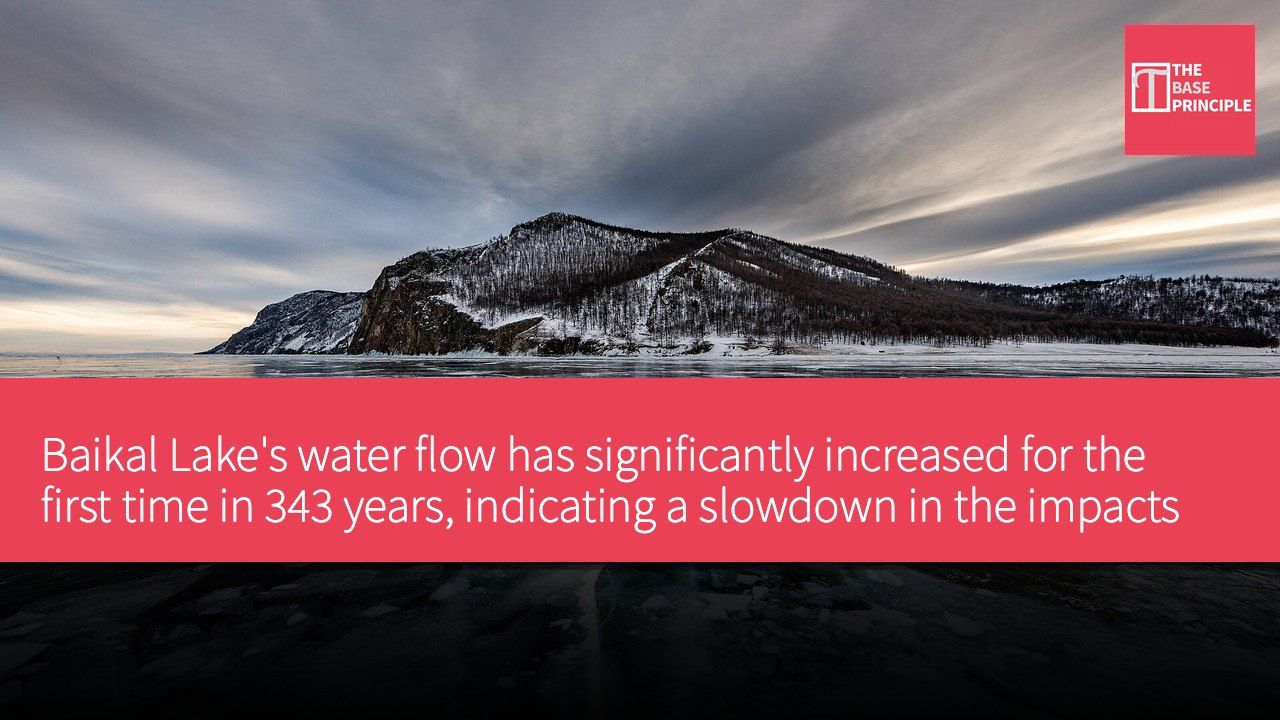
- Baikal Lake's water flow has significantly increased for the first time in 343 years.
- The increase in water flow aligns with changes in Arctic climate conditions, affecting water resource availability.
- The study shows that water flow variability is related to climatic and ecological factors.
- Researchers warn that the sustainability of the increased water flow still needs further confirmation.
Located in Siberia, Baikal Lake contains about 20% of the world's surface freshwater. However, due to the adverse effects of climate change, the lake has been facing the threat of drying up. A new study suggests that this situation may be changing, and the changes are quite significant. Baikal Lake is the oldest and largest freshwater lake in the world, storing about one-fifth of the Earth's non-frozen surface freshwater. This UNESCO World Heritage site relies on inflows from the Selenga River and discharges through the Angara River. According to the study, this water balance supports agriculture in Mongolia and hydropower generation in regions along the Angara River, affecting the water resource availability for millions of people.
However, in the early 20th century, this water flow experienced a significant decline. Recently, researchers found that since 2017, the water flow has begun to rise sharply, reaching 145.2% of its long-term average. This recovery coincides with rising lake water levels, increased vegetation growth, and changes in Arctic climate conditions. The study, published in the Geophysical Research Letters, indicates that changes in airflow related to regional Arctic warming slowdown may help restore water resource availability in the Baikal Lake basin.
Significant Changes in Water Flow Increase
Wang Shijie and his colleagues from Yunnan University reconstructed 343 years of water flow data using tree-ring records. The researchers collected 52 tree-ring samples from pines near Baikal Lake and combined them with existing records from 12 other locations. Their reconstruction shows that since the early 20th century, water flow has experienced intermittent declines, dropping to a relatively high level of about 90%. Approximately half of the extreme low-flow years occurred after 1900. However, researchers identified a significant reversal around 2017, with water flow recovering to 145.2% of the long-term average, with observations indicating rising lake water levels and increased vegetation growth.
Researchers identified the period from 2017 to 2024 as the most pronounced recovery event in 343 years of records, following a severe decline from 1995 to 2016.
Environmental Factors Affecting Water Flow
Researchers examined environmental factors influencing water flow, including precipitation, temperature, soil moisture, and snowmelt. Their analysis attributed 59.3% of the water flow variability to the combined effects of the climatic and ecological factors studied. They also found significant relationships between water flow and sea surface temperatures and sea ice cover in parts of the North Pacific and Arctic Oceans. Lower sea surface temperatures and higher sea ice cover in the Bering Sea, Chukchi Sea, East Siberian Sea, and Sea of Okhotsk were associated with increased water flow. According to the study, the regional Arctic warming slowdown and the phenomenon of sea ice retreat align with the formation of "Arctic cold blocks."
Researchers suggest that these conditions may alter airflow and increase moisture transport to Baikal Lake. However, further climate modeling is needed to test the proposed connections.
Questions About the Sustainability of Water Flow Increase
Despite these findings, researchers have not determined whether the increase will be sustained. "Determining whether this wet period represents a permanent regime shift or a temporary phase is crucial for assessing its long-term significance," the authors wrote. They also warned that the water flow estimates from 2015 to 2024 exceed the available instrument calibration period, introducing uncertainty. The researchers concluded that long-term records are essential for understanding changes in water resource availability and developing adaptive water resource management strategies. "Our findings suggest that predictions based solely on relatively short instrumental data may not adequately capture the hydrological climate variability of the basin, underestimating the system's inherent capacity to respond to rapid changes," they wrote.
The Impact of Climate Change and Water Resource Management
The increase in Baikal Lake's water flow indicates that the impacts of climate change on water resources may be slowing, which is particularly important for regions that rely on this lake's water source. The study points out that changes in water flow are closely related to changes in Arctic climate, which may affect future water resource management strategies. Although current data show a positive trend, researchers emphasize that future climate change may impact the sustainability of this increase, making long-term monitoring and management of water resources in the region even more critical.