
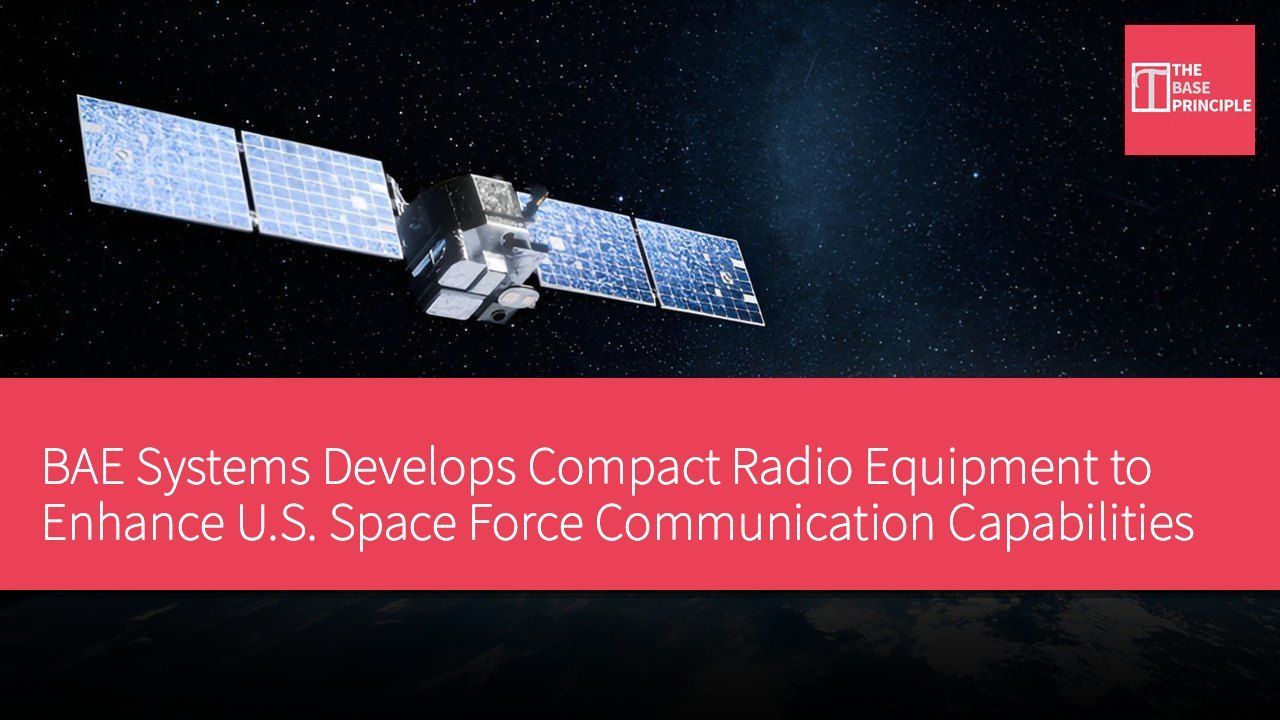
- BAE Systems is developing compact radio equipment for the U.S. Space Force to improve communication.
- These terminals must operate in various orbital environments, designed compactly to fit spatial constraints.
- BAE Systems plans to leverage mature technology to develop terminals resistant to interference.
- Successful demonstrations will aid in establishing the communication infrastructure for the Space Force.
BAE Systems will develop and demonstrate compact radio frequency (RF) terminals for a U.S. Space Force initiative aimed at improving communication between space-based networks. This work will support a space-based data layer designed to facilitate information transfer between military assets operating in orbit. The Space Systems Command (SSC) has awarded the contract to support the military's pursuit of resilient communication capabilities in increasingly challenging space operations. BAE Systems plans to apply its existing space-qualified software-defined radio technology to this project.
These terminals must be capable of operating in various orbital environments, from low Earth orbit (LEO) to geostationary Earth orbit (GEO). Their compact design will also assist in installing communication hardware on spacecraft with limited space.
Design Requirements for Compact Radios
For military networks, compact radios utilize software-defined radio technology that employs programmable processing to handle radio communications, providing flexibility beyond traditional fixed-function hardware. BAE Systems plans to leverage its mature radio technology to develop terminals that maintain reliable connections under challenging conditions. Military spacecraft may encounter intentional jamming and electromagnetic interference, which can disrupt communications. Additionally, space radiation poses a threat to electronic components, making radiation tolerance critical for long-term missions. The new terminals must withstand these conditions while meeting military security requirements.
BAE Systems will also conduct space characterization testing to assess the hardware's suitability for orbital operations. Its engineers will collaborate with government partners to demonstrate the technology and prepare for deployment.
Application programming interfaces (APIs) will assist in coordinating effective pointing, ensuring alignment between communication systems as spacecraft connect with other network elements. Radiation hardening remains essential, and BAE Systems brings a range of radiation-hardened electronic devices to the program. Its existing space hardware includes processors, memory components, programmable logic devices, and communication subsystems built for harsh orbital conditions. According to BAE Systems, its RAD750 single-board computer has powered over 100 satellites.
This processor also supports the navigation payload for GPS III. Its flight history underscores the importance of reliable computing hardware for missions where repairs are difficult or impossible.
BAE Systems also offers the RAD5545 SpaceVPX multicore single-board computer, which integrates processing capabilities that previously required multiple cards, helping to reduce the electronic footprint of spacecraft. Its features include onboard data processing and cybersecurity capabilities. The company's radiation-hardened components also include static random-access memory (SRAM), cosmic-radiation random-access memory (C-RAM), programmable read-only memory (PROM), and field-programmable gate arrays (FPGAs). These technologies support computing and data processing in space and missile defense systems.
To scale production for future missions, Joe Dziezynski, director of BAE Systems' space systems product line, stated that the program builds on decades of experience developing hardware for demanding missions. He mentioned the company's history, from the Apollo program to modern deep space and aerial systems. Dziezynski also noted that established manufacturing capabilities can accelerate deployment and scale production. The Space Force plans to require BAE Systems to demonstrate its proposed terminal technology before entering broader production. The company anticipates that the system's scalable design will meet future Department of Defense requirements.
Engineering Challenges Ahead
This effort reflects the real engineering challenges faced by military space networks: providing compact communication equipment that remains reliable despite interference, radiation, and the physical constraints of spacecraft. Successful demonstrations could help establish these terminals as another component of the evolving orbital communication infrastructure for the Space Force.
Item Specification Processor RAD750 Memory Components SRAM, C-RAM, PROM, FPGAs
BAE Systems' Technical Advantages and Future Outlook
BAE Systems' development of compact radio equipment reflects the current demands and challenges of military space communication. As the complexity of space operations increases, these devices must not only operate in various environments but also withstand various interferences and radiation effects. BAE Systems' historical experience and expertise in hardware development give it an advantage in meeting military needs. Successful technology demonstrations will provide reliable communication support for future military missions and promote the growth of the Space Force.