
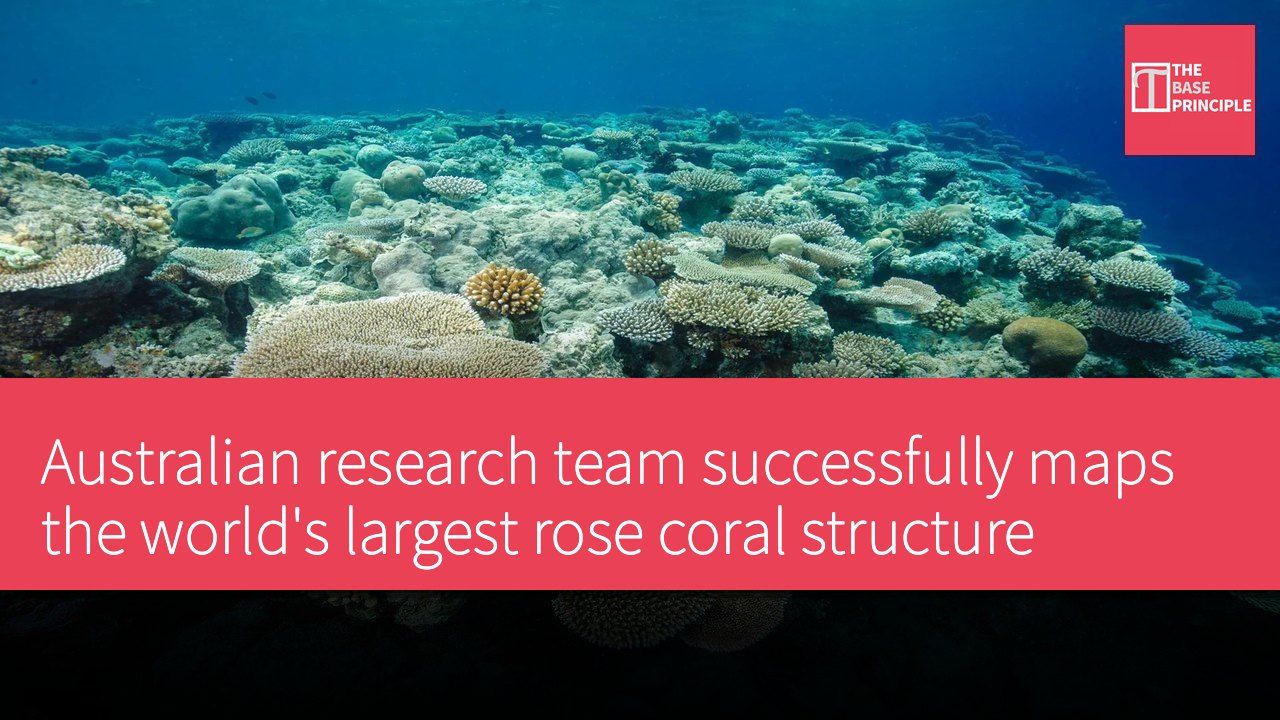
- The research team successfully mapped the world's largest continuous rose coral structure.
- The structure is located in the outer reef area of the Cocos (Keeling) Islands, stretching 0.93 miles long.
- Researchers used GPS to track progress, completing 12 dives to finish the mapping.
- Genetic testing is currently underway to understand the formation of the coral structure and its biological significance.
Marine researchers from the University of Adelaide, Queensland Museum, and James Cook University have successfully mapped and officially designated an astonishing formation, one of the largest continuous rose coral structures on record globally. The structure spans the outer reef area of the Cocos (Keeling) Islands, reaching an impressive length of 0.93 miles (1.5 kilometers). This benthic structure consists of Pachyseris corals, extending up to 0.97 miles (1.56 kilometers) with an average width of 120 feet (36.5 meters), roughly equivalent to 100 buses lined up end to end.
Discovery and Investigation of Rose Coral
The detailed mapping of this massive deep-sea structure involved rigorous surveying by the research team. Over 30 years ago, local diver Dieter Gerhard discovered large areas of rose coral on the outer reef slope at depths ranging from 46 to 213 feet (14 to 65 meters). However, the vast scale of this continuous marine structure was not fully recognized until researchers dedicated themselves to investigating the area, discovering that regions previously thought to be scattered fragments were actually connected into a giant coral colony.
The mapping effort was led by Dr. JP Hobbs from the University of Adelaide, in collaboration with marine scientists from Queensland Museum and James Cook University. Documenting the structure required months of extensive fieldwork. Due to its great length and depth, Dr. Hobbs used GPS coordinates to track progress while diving, ensuring he could reach the end of the structure before running low on air supply. A total of 12 dives were needed to map the entire structure. The main structure covers an area of 613,000 square feet (56,940 square meters), equivalent to the size of three sports fields.
Significance of Genetic Testing
Beyond the main boundaries of the coral colony, the investigation also identified additional isolated areas extending between 656 and 984 feet (200 to 300 meters). Despite successfully mapping this massive underwater biological structure, questions remain about how such a large colony exists. The research team is currently investigating whether this astonishing extension constitutes a continuous genetic entity that has grown outward for centuries or is the result of multiple independent colonies merging over time.
To address this question, researchers are collaborating with scientists from Queensland Museum to extract samples for advanced genetic testing. The findings are expected to provide crucial insights into the long-term resilience of Australia's remote marine environments and deep-sea reef ecosystems. The research team is currently working to determine whether this remarkable coral extension constitutes a single, continuous genetic organism or is the result of multiple independent colonies merging over time. To answer this fundamental biological question, researchers are extracting samples and conducting genetic tests across different regions. The results of these genetic analyses, with support from Queensland Museum scientists, are anticipated to offer important insights into the resilience, growth patterns, and unique biological communities of Australia's remote deep-water marine environments.
Revealing the Biological Mysteries of Coral Structures
This research not only showcases the vast structure of rose coral but also sparks an in-depth exploration of its biological formation. Through genetic testing, the research team hopes to understand whether these corals represent a single genetic entity or a fusion of multiple independent colonies. This is crucial for understanding the resilience of coral ecosystems and their adaptability in the face of environmental changes, especially against the backdrop of escalating climate change impacts.