
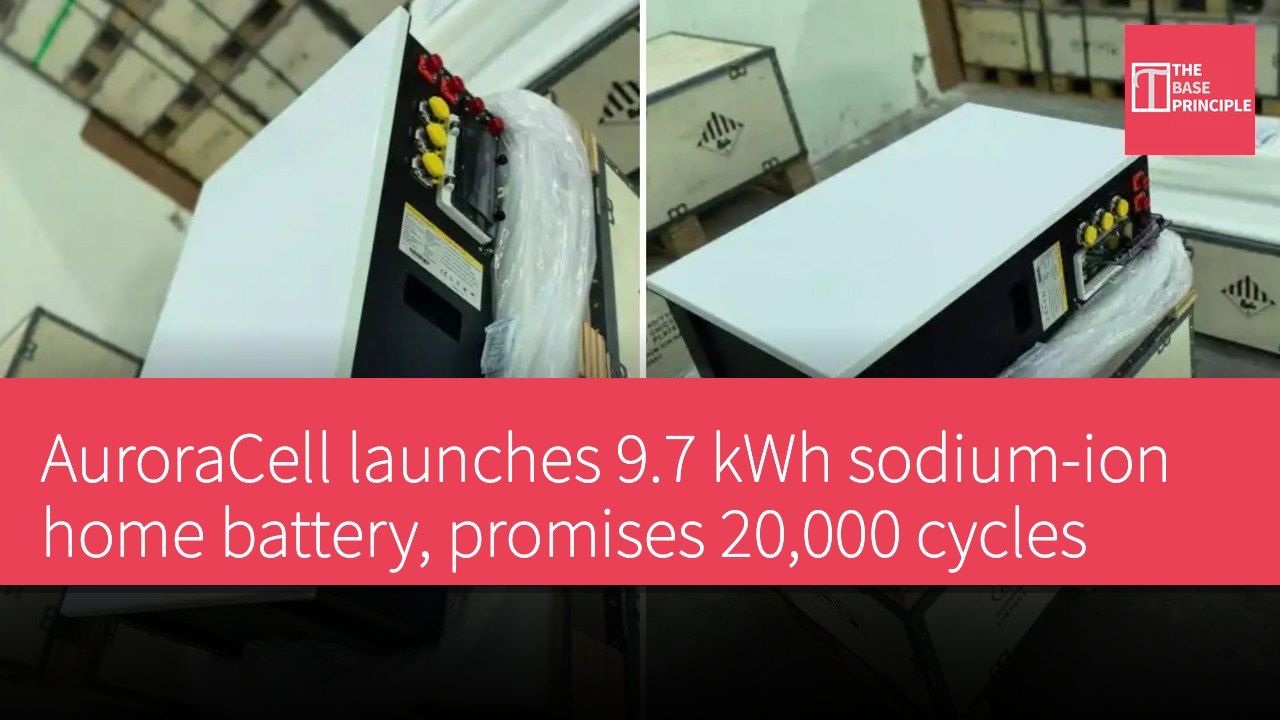
- AuroraCell's sodium-ion battery withstands 20,000 cycles, exceeding the lifespan of typical lithium batteries.
- The battery operates normally in extreme temperatures and has obtained UL9540A and CE certification.
- AuroraCell's battery design is safe, avoiding fire or explosion risks, suitable for harsh environments.
- Sodium-ion technology helps reduce production costs and decrease supply chain vulnerability.
Home energy storage systems are undergoing a transformation. AuroraCell, headquartered in Bulgaria, has developed a 48 V residential energy storage system (RESS) that employs sodium-ion chromium oxide (NCO) cathode technology. Standard lithium batteries are constrained by supply issues and carry a risk of fire. Sodium batteries are seen as a potential alternative to resolve this crisis. However, conventional sodium batteries typically require compromises between energy density and stability in extreme weather. AuroraCell says its purpose-built NCO structure overcomes these compromises.
The unit reportedly withstands 20,000 cycles at 100% depth of discharge, a figure that exceeds the warranty period of typical lithium-ion batteries by decades. AuroraCell provides a 20-year guarantee for the system.
Sodium-ion battery cycle life
The AuroraCell 9.7 kWh battery stores enough power to run essential home electronics and appliances. It operates as a standard 48-volt system, providing homeowners with reliable backup power. Safety is also a key advantage, as the design guarantees no fire or explosion. The product has obtained both UL9540A and CE safety certifications. Its tolerance for temperature variation is equally noteworthy, capable of discharging without issue in low temperatures and continuing to operate in extreme heat up to 60°C (140°F).
ESS News reports the unit weighs 110.5 kg and can connect directly to a main 48 VDC hybrid inverter, with supported brands including Victron, Schneider Electric, SMA, and Sungrow. Thanks to its modular parallel connection, homeowners can easily expand the system's capacity.
Safety and environmental adaptability
The unit's enclosure carries an IP65 rating and measures 483 mm × 254 mm × 754 mm. The IP65 rating ensures the unit is weatherproof and fully protected against dust and water jets. As a result, the system is suitable for harsh indoor or outdoor environments. Sodium technology provides a safe and durable foundation for residential energy storage. Generally, these batteries have an expected service life of 25 to 30 years, with a projected cycle life exceeding 30,000 cycles. Such longevity is well suited for homeowners who charge and discharge solar daily, without needing to replace the unit frequently.
For these reasons, AuroraCell combines stable chemistry, built-in management, and passive thermal protection to create an ultra-safe home battery.
In addition, AuroraCell has another product. The Nexus TerraShield 200 NFPP is a high-capacity battery designed by AuroraCell for commercial and utility-scale energy projects. The battery provides nearly 200 kWh of storage, using sodium-ion technology to offer a cost-effective and sustainable alternative to large-scale lithium battery installations. According to the company's website, the 200 kWh commercial unit is equipped with an active liquid cooling system to handle higher energy throughput, while the residential unit relies on passive thermal design.
Advantages of sodium-ion technology
Sodium-ion batteries reduce supply chain vulnerability by using abundant sodium instead of scarce metals such as lithium, nickel, or cobalt. The use of inexpensive aluminum foil in place of costly copper foil significantly lowers the production cost of sodium batteries. Moreover, existing lithium-ion gigafactories can quickly adapt standard equipment for sodium-ion production with almost no reconfiguration. All of these advantages may ultimately help sodium batteries move closer to mainstream adoption, rather than relying solely on lithium batteries.
Item Specification Battery capacity 9.7 kWh Weight 110.5 kg High temperature resistance 60°C Cycle life 30,000 cycles or more Dimensions 483 mm × 254 mm × 754 mm
Market potential and challenges of sodium-ion batteries
AuroraCell's sodium-ion batteries not only surpass traditional lithium batteries in performance but also have significant advantages in safety and environmental adaptability. As demand for sustainable energy solutions increases, the development of sodium-ion technology may become an important option for future home energy storage. Due to the abundance of sodium resources, this technology can effectively reduce production costs and decrease reliance on scarce metals. However, market acceptance and technological maturity remain key factors in whether sodium-ion batteries can successfully replace lithium batteries.