
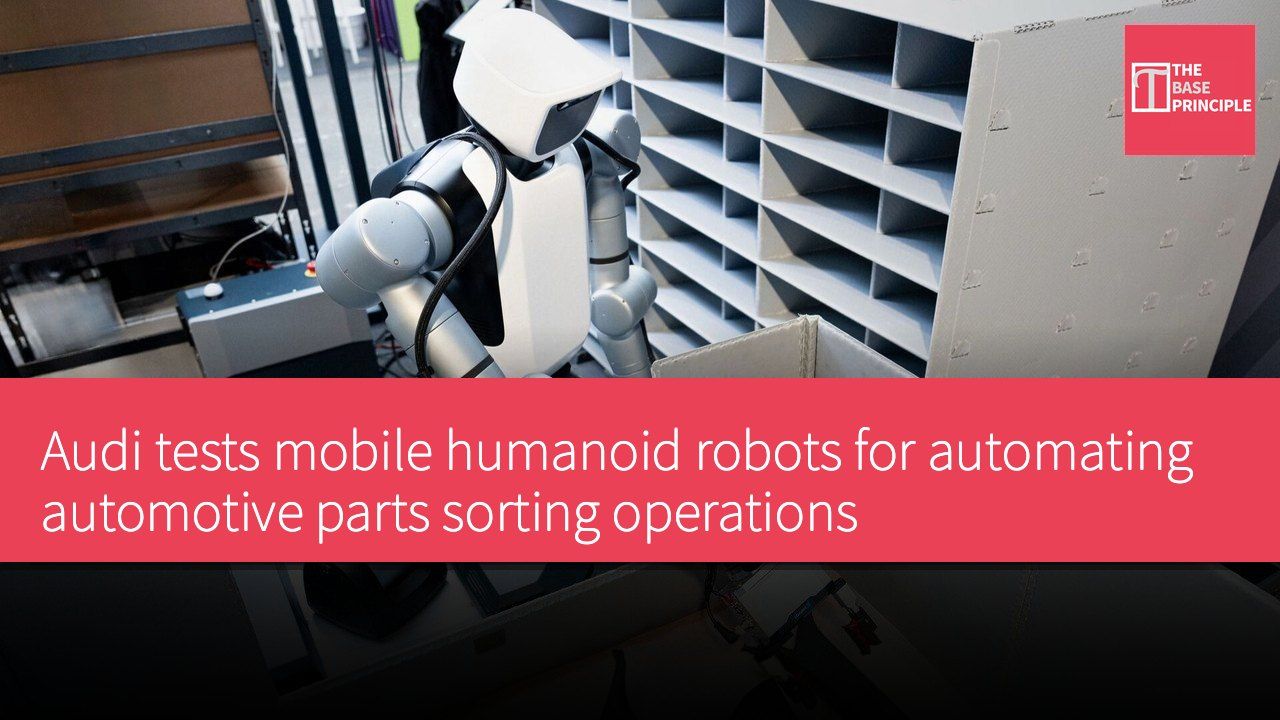
- Audi is testing a mobile humanoid robot to automate parts sorting.
- The project combines robotic operations, artificial intelligence, and virtual simulation technologies.
- The robot faces challenges in identifying and handling various components.
- The project is still in the proof of concept stage, with no confirmed deployment timeline.
Audi is testing a mobile humanoid robot developed by Agile Robots at its production lab in Ingolstadt, Germany, to automate parts sorting. The proof of concept focuses on picking components from containers and arranging them in the correct order for subsequent assembly operations. This project brings together Audi, Agile Robots, Dassault Systèmes, and NVIDIA to explore the application of humanoid robots in automotive manufacturing. The initiative combines physical robot testing with virtual simulation, but no quantified performance results or broader factory deployment timelines have been disclosed.
Audi is testing a mobile humanoid robot at its Ingolstadt production lab to automate parts sorting. The proof of concept combines robotic operations, artificial intelligence, and virtual simulation to explore how robots can pick components from containers and arrange them in the correct order for automotive assembly. The project was announced on October 21 at the NVIDIA GTC Berlin conference, aiming to automate material handling tasks, which remain a challenge for traditional industrial robots due to the varying shapes, packaging, and positions of components. Audi's material supply operations require approximately one million picks daily, with components needing to be delivered to assembly workstations in the correct order.
This figure describes the scale of the existing workflow, rather than the performance achieved by the humanoid robots.
Technical Challenges for Humanoid Robots
The trials use the Agile One humanoid robot, designed to combine human-like reach and dual-arm operation with the flexibility of a wheeled base. This configuration allows the robot to operate in existing industrial environments without the need to redesign factories to accommodate fixed robotic workstations. These robots are currently being tested in Audi's production lab, where the company is evaluating technologies for future manufacturing and logistics operations. The system is designed to retrieve components from material containers and place them in a predetermined order for subsequent assembly use.
Gerd Walker, a member of the Board of Production and Logistics at AUDI AG, stated in a release: "For decades, picking in the sorting process has been one of the most challenging automation tasks in automotive logistics. Now, we are exploring, together with our partners, how to leverage AI-driven robots to tackle this challenge and unlock new levels of productivity in our Audi factories."
Handling unsorted components presents several technical challenges. The robot must identify individual parts, determine how to grasp them, and extract them without damage while positioning them correctly. Flexible or semi-rigid components are particularly difficult to handle, as they may deform during operation. AI-driven perception and dual-arm coordination are intended to help Agile Robots' system address these challenges. This approach could extend automation to parts handling tasks that are difficult to execute reliably, which typically require traditional systems designed for specific objects and carefully controlled environments.
Applications of Virtual Testing
However, the announcement did not provide measurements of picking speed, error rates, or other performance results from the trials. The project also employs virtual simulation to evaluate the robots before deploying them in Audi's logistics operations. Dassault Systèmes is using its DELMIA application and 3DEXPERIENCE platform to create a virtual twin of the logistics environment. This digital environment will allow engineers to assess the feasibility of proposed robotic tasks and evaluate cycle times, ergonomics, and safety. The NVIDIA Omniverse database provides additional capabilities for simulating interactions between physical environments and robots.
Virtually testing these factors can help engineers identify potential issues before conducting physical tests and provide a way to examine different operational conditions without repeatedly interrupting real production processes.
The partners also plan to use AI-driven virtual assistants to support engineering workflows, accelerating development and validation. This initiative is part of a broader effort in the automotive industry to leverage humanoid robots for logistics and manufacturing tasks. Its practical value will depend on the system's ability to reliably handle various components, operate at effective production speeds, and function reliably within existing factory infrastructure. Currently, Audi's project remains a proof of concept, with no confirmed timeline for deployment across the factory.
Future Challenges in Automating Automotive Parts Sorting
Audi is collaborating with Agile Robots to automate the sorting process of automotive parts using humanoid robots. The success of this technology could significantly enhance production efficiency, especially when handling components with varying shapes and packaging. However, the robots must overcome technical challenges related to identification and grasping, which remain difficult tasks for traditional industrial robots. Additionally, the use of virtual simulation to identify potential issues before physical testing will help mitigate risks in the production process. Overall, the practicality of this technology will depend on its stability and reliability within existing factory environments.