
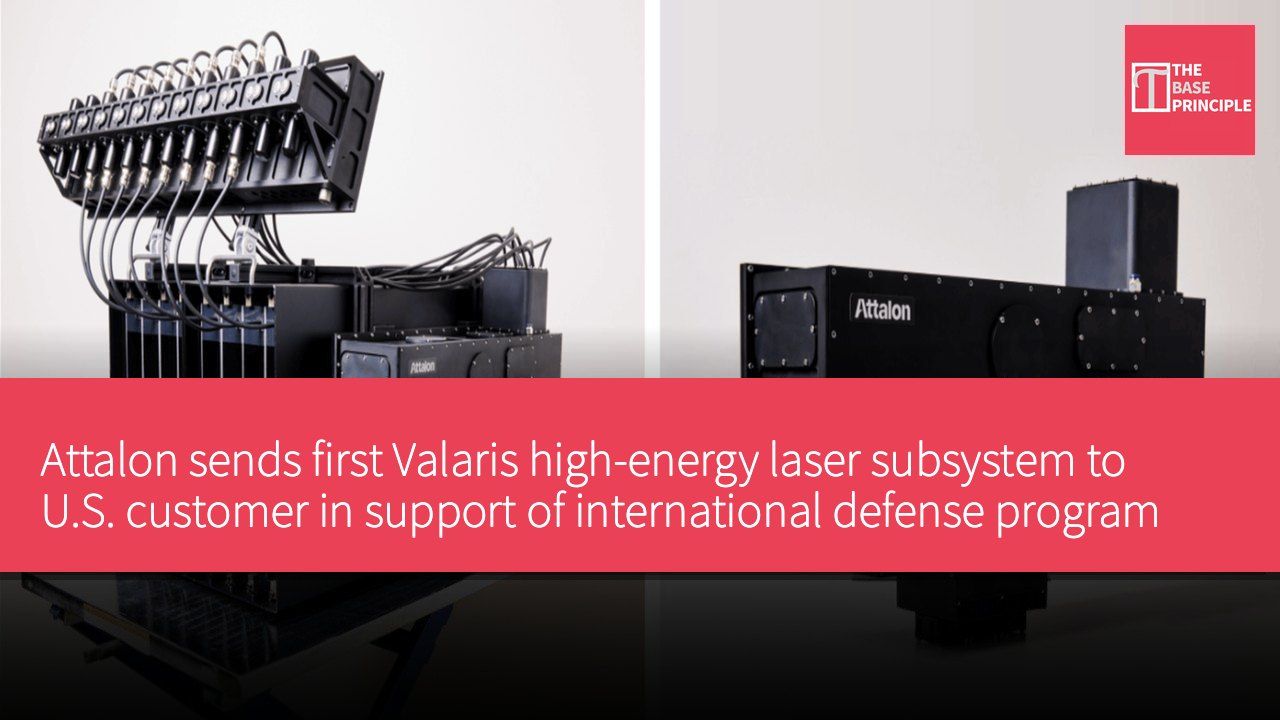
- Attalon delivers its first Valaris high-energy laser subsystem to a U.S. customer.
- The subsystem is intended to support an international defense program, signaling growing demand.
- AeroVironment signs a long-term agreement with Attalon to obtain laser subsystems.
- The U.S. Army is investing in high-energy laser systems to counter drone threats.
Attalon has delivered its first Valaris high-energy laser subsystem to a U.S. customer in support of an international defense program, as directed-energy capabilities among U.S. allies continue to expand. The company recently announced that the subsystem has been shipped to the U.S. customer. Designed and manufactured in the United States, the subsystem marks the company's first Valaris unit produced for an international end-use requirement. "This milestone demonstrates growing demand for Valaris and high-energy laser technology that can be produced, deployed and maintained at scale," said Attalon CEO John Bergeron. "Attalon is building this capability in the U.S. to support American warfighters while extending proven, American-made technology to allied forces worldwide as they enhance their own capabilities."
The shipment comes as Attalon expands its production capacity and broadens the application of Valaris technology across domestic defense programs. According to the press release, Valaris is a family of "mission-ready, beam-combined high-energy laser subsystems" designed for integration into operational defense systems. The term refers to coherent, spectral and dichroic beam-combining architectures spanning power ranges from 5 kW to more than 400 kW. The company also recently announced a $15 million investment in its U.S. directed-energy manufacturing capability, reflecting rising demand for high-energy laser systems.
AeroVironment signs long-term agreement
According to the Defense Post, AeroVironment is signing a long-term agreement with Attalon to obtain laser subsystems, supporting the large-scale production and deployment of its high-energy laser systems.
The agreement centers on Attalon supplying its Valaris S laser subsystem to AeroVironment's growing portfolio of high-energy laser programs, including the LOCUST weapon, which has been approved for production by the U.S. Army. "AV is actively scaling up our LOCUST production capacity to meet near-term demand, ensuring our defense technology is ready before the need arises," said Mary Clum, president of AeroVironment's Space, Cyber and Directed Energy division.
U.S. Army investment in high-energy lasers
The U.S. Army is investing in high-energy laser systems to counter drone operations. According to the National Interest, the Army will pay AeroVironment $464.8 million for a new laser weapon system designed to shoot down aerial drones. AeroVironment will provide dozens of LOCUST X3 systems as part of a multi-year deployment under the Army's ongoing high-energy laser program. The 30-kW LOCUST X3 supports the Army's layered air defense against Group 1-3 unmanned aerial systems and can be integrated with military vehicles including the Joint Light Tactical Vehicle.
Attalon's subsystems will play a key role in the program's success, although the press release did not specify the destination of its first Valaris shipment. However, as Army Vice Chief of Staff Christopher LaNeve told the National Interest, AeroVironment's LOCUST system reflects the "first directed-energy program" aimed at enabling the military to "defeat unmanned systems." He said combining "human ingenuity with advanced technology" ensures the Army "continues to outpace America's adversaries."
Attalon's first international Valaris shipment extends a U.S.-manufactured platform beyond domestic defense programs as the company expands production at home and supplies Valaris technology to high-energy laser systems entering U.S. Army production.
Strategic significance of high-energy laser technology
Attalon's delivery of its Valaris high-energy laser subsystem underscores U.S. emphasis on directed-energy weapons, particularly in addressing drone threats. As demand for such technology grows among U.S. allies, successful deployment of the system will enhance the defensive capabilities of the United States and its partner forces. In addition, AeroVironment's long-term agreement signals strong market demand for high-energy laser systems and is driving the development and production of related technologies. These developments reflect not only shifting military requirements but also the potential applications of high-energy laser technology in modern warfare.