
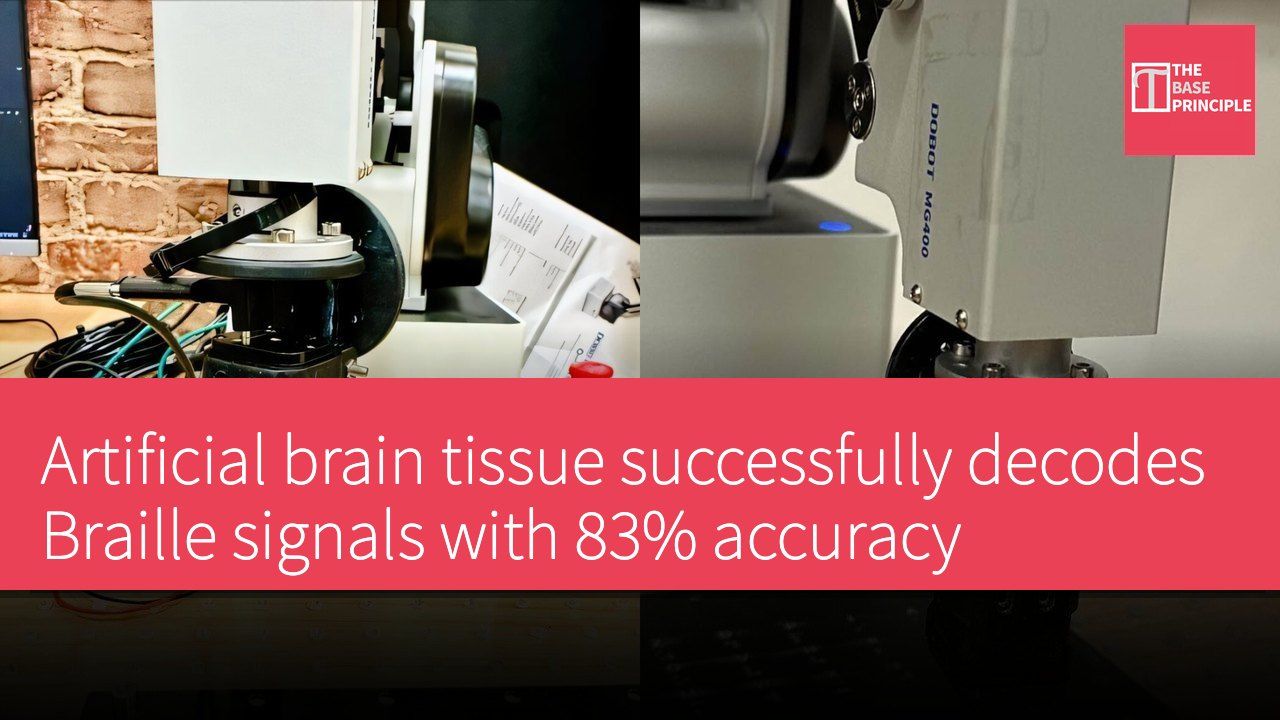
- Researchers successfully used a human brain model to decode Braille signals.
- When three brain organoids worked together, the recognition accuracy reached 83%.
- The natural variations among the brain organoids may enhance their performance.
- The team hopes to explore more tactile applications in the future.
Researchers at the University of Bristol in the UK report that a lab-grown human brain model successfully received Braille signals emitted by tactile sensors and responded in a format that can be decoded by computers, marking an early step toward energy-efficient biological hybrid computing. The study found that each Braille letter generated a unique activity pattern in the brain organoids. The computer decoder identified letters emitted by a single brain organoid with about 61% accuracy, while the accuracy increased to 83% when three brain organoids worked together.
The system consists of brain organoids placed on a multi-electrode array, which is housed in a device to sustain the life of the brain organoids and record their responses. Each brain organoid has a diameter of less than one millimeter (approximately 0.04 inches), lacking several structures found in a real brain but containing about 10,000 neurons and their supporting cells. The array can receive electrical signals. The research team first ran tactile sensors on 26 Braille letters, converting the readings into electrical stimulation patterns and transmitting them to the brain organoids, then checking whether the resulting neural activity indicated the letters sent.
Researchers used a support vector machine, a simple machine learning algorithm, to classify the activity patterns by letter.
Advantages of Brain Organoid Performance
Researchers are unclear why the performance of three brain organoids exceeds that of a single brain organoid. One possibility is that natural differences among the brain organoids, such as network connectivity, developmental state, and sustained activity, allow them to complement each other. First author Liu Tianyi stated that combining the responses of multiple brain organoids may provide information that a single brain organoid cannot obtain, but this variability also makes constructing a predictable standardized system more challenging. Senior author Benjamin Ward-Cherrier noted that tactile data still contained enough information for accurate classification of Braille letters after processing by the brain organoids, and combining multiple brain organoids could further enhance performance.
To test the robustness of the system, the team applied different noise filters to the Braille signals and then compared the two methods using the same support vector machine: one decoding from the responses of the brain organoids and the other decoding directly from intentionally blurred signals. The three brain organoids demonstrated a stronger ability to identify letters in artificial noise, while direct decoding was more susceptible to interference.
Future Research Directions
Researchers emphasized that these experiments did not demonstrate whether brain organoids can learn over time. They only indicated that brain organoids received and responded to Braille signals. Liu Tianyi pointed out that the study also used a single tactile task, a fixed coding scheme, and relatively simple measurements of neural activity, and did not show learning or long-term changes. Moving forward, Liu Tianyi stated that the team hopes to go beyond Braille to explore textures, edges, and other types of tactile stimuli, ultimately entering closed-loop tasks that provide feedback on the actions of the brain organoids, allowing researchers to investigate whether brain organoids can adapt through experience.
The study was published on October 16 in the journal Frontiers in Artificial Intelligence.
Potential and Challenges of Brain Organoid Technology
This research demonstrates the potential of brain organoids in decoding Braille signals, highlighting their application prospects in the field of biological hybrid computing. Although the collaboration of three brain organoids improved recognition accuracy, researchers still need to address the challenges of standardizing systems. Future research directions include exploring more types of tactile stimuli and their applications, which could not only advance the development of related technologies but also provide deeper insights into neuroscience, particularly regarding learning and adaptation capabilities.