
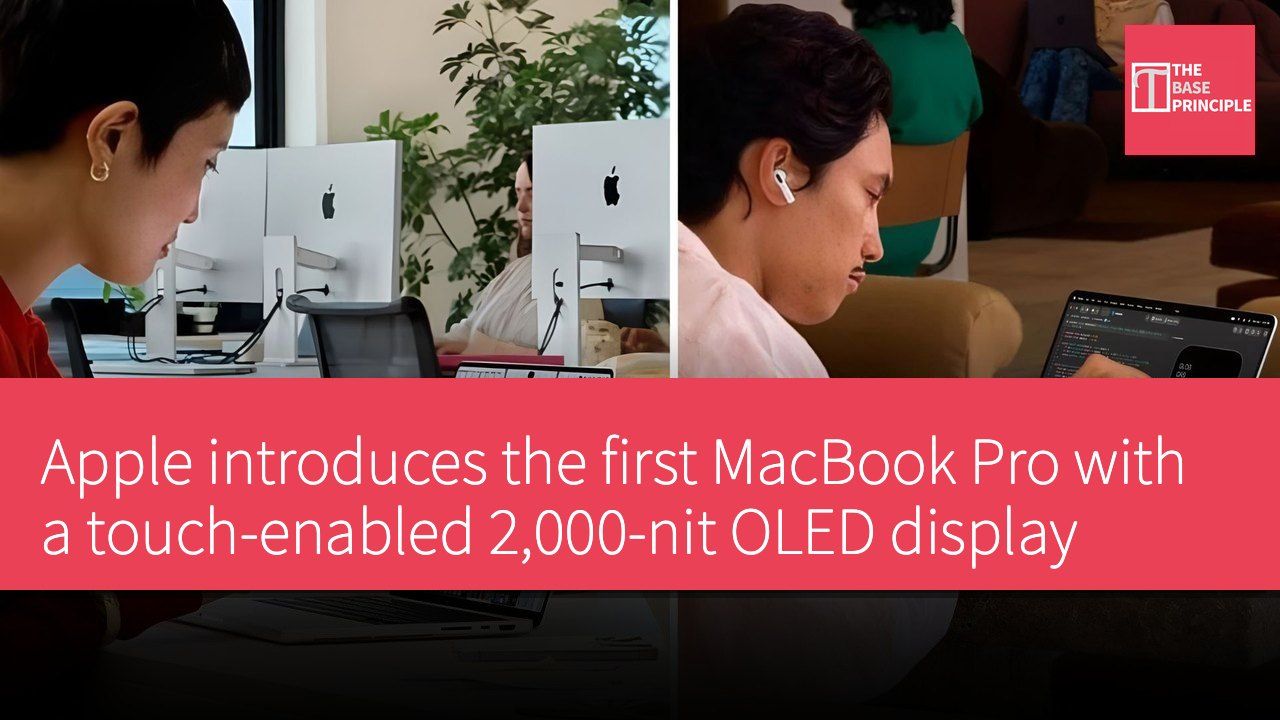
- Apple has introduced touch screen control to the MacBook Pro, powered by the new M5 Pro and M5 Max processors.
- The new display features dual OLED technology, offering brightness of up to 2,000 nits and excellent contrast.
- The touch functionality allows users to interact directly with the display, enhancing productivity for creative professionals.
- The M5 Pro and M5 Max processors are designed for intensive computing and professional applications, delivering exceptional performance.
Apple has introduced touch screen control to the MacBook Pro for the first time, combining this highly anticipated feature with dual OLED displays and the new M5 Pro and M5 Max processors. The redesigned 14-inch and 16-inch laptops are lighter than their predecessors and promise up to 24 hours of battery life. The revamped MacBook Pro also brings back Apple's glowing logo, which has not been seen since 2016, reintroducing a signature design element of the brand.
This return comes a decade after Apple removed the glowing logo during its shift to thinner laptop designs. This announcement marks the third major product launch this year by Apple CEO John Ternus, following the releases of the iPhone 18 Pro and iPhone Duo, and then the OLED-equipped iPad mini. The new display and touch interface for the MacBook Pro represent a significant evolution in Apple's professional laptop lineup.
Pre-orders will begin on October 28, with deliveries and retail availability starting on November 6. The starting price for the 14-inch M5 Pro model is US$2,899 (approximately HK$22,563).
Advantages of the New Display Technology
Apple's new PROLED XDR display utilizes dual OLED technology to enhance brightness, contrast, and image consistency. It boasts a peak brightness of 2,000 nits and claims to provide a contrast ratio of 10,000,000:1. The variable refresh rate can reach up to 120Hz, ensuring smooth dynamic effects during editing and other demanding tasks. We are excited about the new MacBook Pro, and you have to experience it in person to believe it.
The panel supports P3 and Adobe RGB color gamuts, making it ideal for photographers, designers, and video editors. Apple claims that HDR video work covers over 80% of the Rec. 2020 color gamut. An anti-reflective coating helps users work in bright environments, while an optional nano-texture surface further reduces glare. Apple also employs dedicated processing algorithms to adjust individual pixels, maintaining consistent brightness. Factory calibration helps ensure color accuracy aligns with professional standards. The company has also added reference modes for professional work, including non-diagnostic medical imaging review.
Touch Functionality Enhances User Experience
The touch functionality provides an additional navigation method for macOS without replacing the keyboard or trackpad. Users can directly zoom, move presentations, and rearrange windows on the display. The integrated touch sensors reduce latency by placing sensing technology within the panel. Creative professionals also have more specialized options. Designers can draw directly on the screen, while musicians can use screen controls to play software instruments. Developers can also test touch interactions in their iOS and iPadOS applications. Apple has redesigned the hinge to provide greater stability during touch use.
Existing applications can recognize touch input through automatic conversion to clicks. Developers can also use updated gesture APIs to build interfaces specifically for the new display.
Performance Enhancements of the Professional Processors
The M5 Pro is aimed at professionals in software development, scientific computing, and intensive video editing. The M5 Max is suited for heavier workloads, including 3D animation, visual effects, and large language models running locally. Both processors feature GPU cores with dedicated neural accelerators and third-generation ray tracing engines. Apple states that these improvements accelerate graphics rendering and demanding computational tasks. Configurations offer up to 128GB of unified memory and 16TB of storage. According to Apple, the redesigned laptops are lighter without sacrificing sustained performance.
The 14-inch model weighs 3 pounds, while the 16-inch version weighs 4 pounds. Both include Thunderbolt 5, HDMI, an SDXC card slot, and Wi-Fi 7.
The 14-inch M5 Pro MacBook Pro starts at US$2,899 (approximately HK$22,563) in the U.S. The 16-inch M5 Pro version starts at US$3,399 (approximately HK$26,503). The M5 Max configuration starts at US$4,499 (approximately HK$35,095) for the 14-inch model and US$4,799 (approximately HK$37,380) for the 16-inch version. Apple has also upgraded the six-speaker sound system, promising 50% deeper bass.
These laptops support up to three external displays with the M5 Pro and four with the M5 Max, providing professionals with more space for complex workflows.
Item Specifications Processor M5 Pro / M5 Max Memory Up to 128GB Storage Up to 16TB Display 14-inch / 16-inch PROLED XDR Weight 14-inch 3 pounds / 16-inch 4 pounds
Impact of the New MacBook Pro on the Professional Market
The newly launched MacBook Pro from Apple, equipped with touch functionality and advanced OLED displays, demonstrates its further positioning in the professional market. These enhancements not only improve the user experience but also provide more efficient tools for creative professionals such as designers and video editors. With the introduction of the M5 Pro and M5 Max processors, Apple has further strengthened its products' capabilities in intensive computing and graphics rendering, showing its commitment to meeting professional market demands. These changes may attract more professional users to choose Apple's ecosystem, thereby enhancing its market competitiveness.