
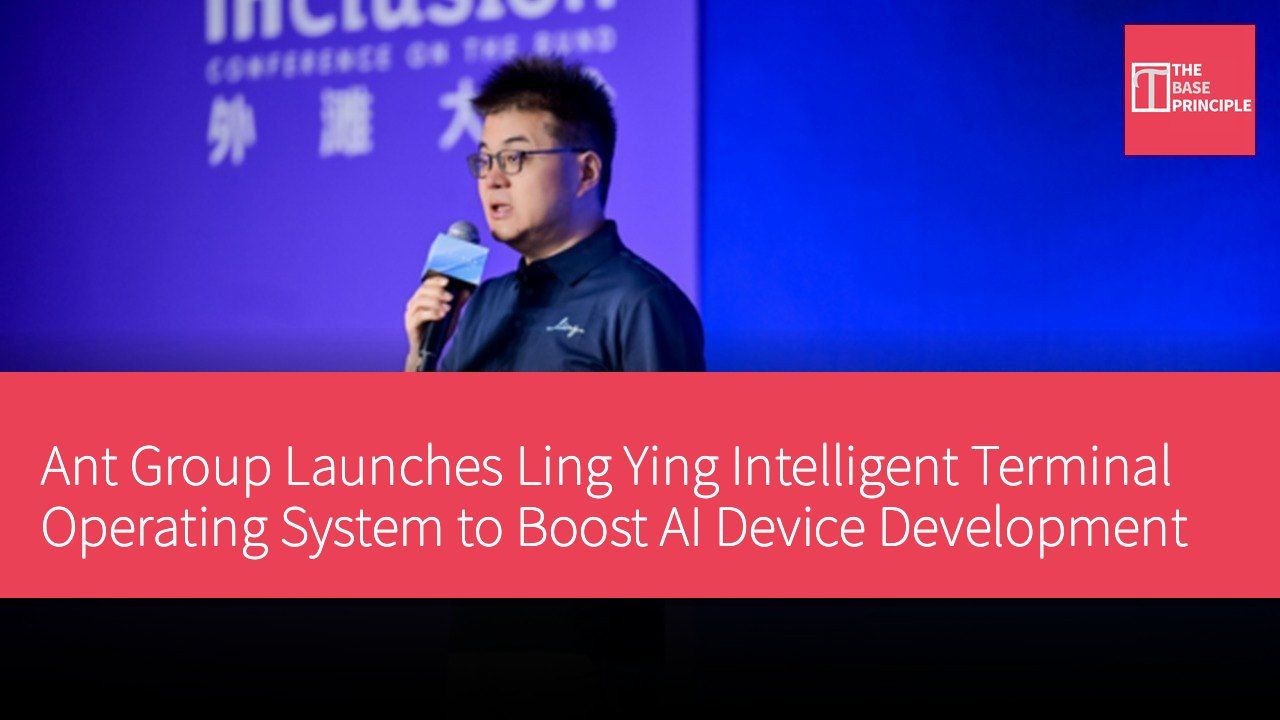
At the "AI-Driven New Terminals, New Services" forum during the 2026 Inclusion·Bund Conference, Ant Group announced the official upgrade of its GPASS intelligent terminal trusted connection technology framework to "Ling Ying." Ling Ying aims to provide a native operating system and open platform for new terminals such as AI glasses, offering foundational capabilities in natural interaction, intelligent agent operation, multi-terminal collaboration, and security and trust. It will be open to chip partners, hardware manufacturers, and developers. Ant Group Senior Vice President Zhou Zhifeng stated that AI terminals are driving changes in the human-computer relationship, with devices shifting from passively waiting for user operations to proactively understanding user intentions and providing collaborative services.
Zhou Zhifeng pointed out, "Ant Group does not make hardware, but we want to be the ones 'paving the road.' We hope to solidify identity, security, payment, and cloud-terminal collaboration capabilities into infrastructure, allowing manufacturers and developers to focus more on product and scenario innovation." As AI terminals develop, the competition is no longer just about hardware parameters but requires new software and service infrastructure to support it.
Ling Ying Technology Framework Will Drive Innovation and Development of AI Terminals
In the past, the core task of terminals was to present information to users, with users actively operating devices through screens, keyboards, and touch controls. The arrival of AI has changed this relationship: devices begin to understand what users see, say, and the environment they are in, and proactively call intelligent agents and services to complete tasks. New terminals such as AI glasses, earphones, and smart rings are gradually becoming important carriers of this change, with interaction entry points moving from keyboards and touch screens further towards voice, vision, gestures, and eye movements. The competition among terminals is also starting to shift towards understanding user intentions, connecting digital services, and completing real-world tasks.
In 2017, Alipay conceived a service form through the "Shadow Project" that would free users from the constraints of mobile phones: users would only need to glance or speak, and services would naturally occur. With the rapid development of AI terminals, this vision is gaining new technical carriers. At last year's Bund Conference, Ant Group released GPASS and explored services such as glass payments, city tour guides, shared cycling, and parking fee payments with multiple terminal partners. However, as time went on, issues such as repeated chip and system adaptation, difficulty in unified invocation of hardware capabilities, fragmented service ecosystems, and identity and authorization risks during the execution of intelligent agents gradually emerged.
The upgrade of GPASS to "Ling Ying" signifies Ant Group's desire to further deepen from application and service connections into the intelligent agent operation base of AI terminals. Ling Ying has established an intelligent agent operation framework that covers interaction, orchestration, strategy, execution, tools, and memory, and connects downward with mobile phones, AI glasses, earphones, and other multi-modal terminals. Users can express their needs through natural language and multi-modal methods, and the system will understand intentions based on context and coordinate devices, intelligent agents, and services within a defined authorization scope to complete tasks.
Ling Ying will unify the abstraction of hardware capabilities such as photography, display, sensors, and temple interactions, reducing repeated adaptations between different chips, systems, and devices, allowing developers to focus more on applications and services themselves. If AI models give machines "intelligence," then intelligent agents give machines "action capabilities." The problem AI terminals need to solve is how to truly bring this action capability into the real world, which also promotes the emergence of new divisions of labor in the AI new economy infrastructure.
Ling Ying hopes to become an infrastructure layer connecting intelligent agents with terminals, and terminals with services, allowing hardware from different manufacturers to share intelligent agent capabilities, and services developed by different developers to run on multiple terminals. Security capabilities are also built into the operation chain of Ling Ying, with the system verifying trusted identities from device access, isolating sensitive data locally, and establishing trusted links for cross-device connections. When intelligent agents call tools or execute tasks, the system will perform identity authentication and authorization, and related operations can be traced.
In addition, Ant Group is also working with the Tai'er Terminal Laboratory of the China Academy of Information and Communications Technology to promote the construction of evaluation laboratories and the formulation of safety standards, providing support for AI terminals to achieve human-centered, safe, and reliable interactions from the perspectives of technical evaluation and standard specifications. Ling Ying hopes to ensure that AI terminals, while gaining the ability of "autonomous action," have clear boundaries in the execution process through built-in security mechanisms and in combination with evaluation and standard construction: who is calling, what is being called, what authorization has been obtained, and how to trace if something goes wrong.
Whether AI terminals can form a scale depends not only on the products of a single manufacturer but also on whether chips, hardware, operating systems, intelligent agents, and application services can form synergy. Ling Ying will connect chip partners, terminal manufacturers, and developers through an open platform. For hardware manufacturers, a unified capability access layer can reduce underlying adaptation and product development costs; for developers, Ling Ying provides tools such as process orchestration, interface components, hardware plug-ins, and application publishing, supporting the reuse of application capabilities on different terminals; for users, lightweight applications can be naturally invoked according to the scene and used immediately, reducing complex operations on small-screen or even screenless devices.
At the launch event, Ling Ying demonstrated reference design prototypes of multiple generations and public board solutions from partners, exploring terminal experiences under dual full-color, iris eye movement, and various chip architectures. During the Bund Conference, related capabilities will also enter real-world scenarios such as Yu Garden Mall and BFC Bund Financial Center, allowing users to experience services such as city tour guides through AI glasses. Zhou Zhifeng stated that the AI terminal industry does not need another closed system but a path that more partners can participate in. In the future, Ling Ying will continue to promote multi-chip adaptation, terminal capability openness, and developer ecosystem construction, and work with industry partners to explore new interactions and services for AI terminals.
From "GPASS" to "Ling Ying," what Ant Group is trying to do is not to recreate a hardware brand but to solidify capabilities such as identity, security, payment, intelligent agents, and cloud-terminal collaboration into open infrastructure. Similar to how APASS establishes commercial trust in intelligent agents, Ling Ying is more concerned with how to truly connect intelligent agents with real terminals and services. Solving the dual problems of "trust" and "connection" together constitutes the infrastructure needed for intelligent agents to move from the digital world to real commerce and real life.