
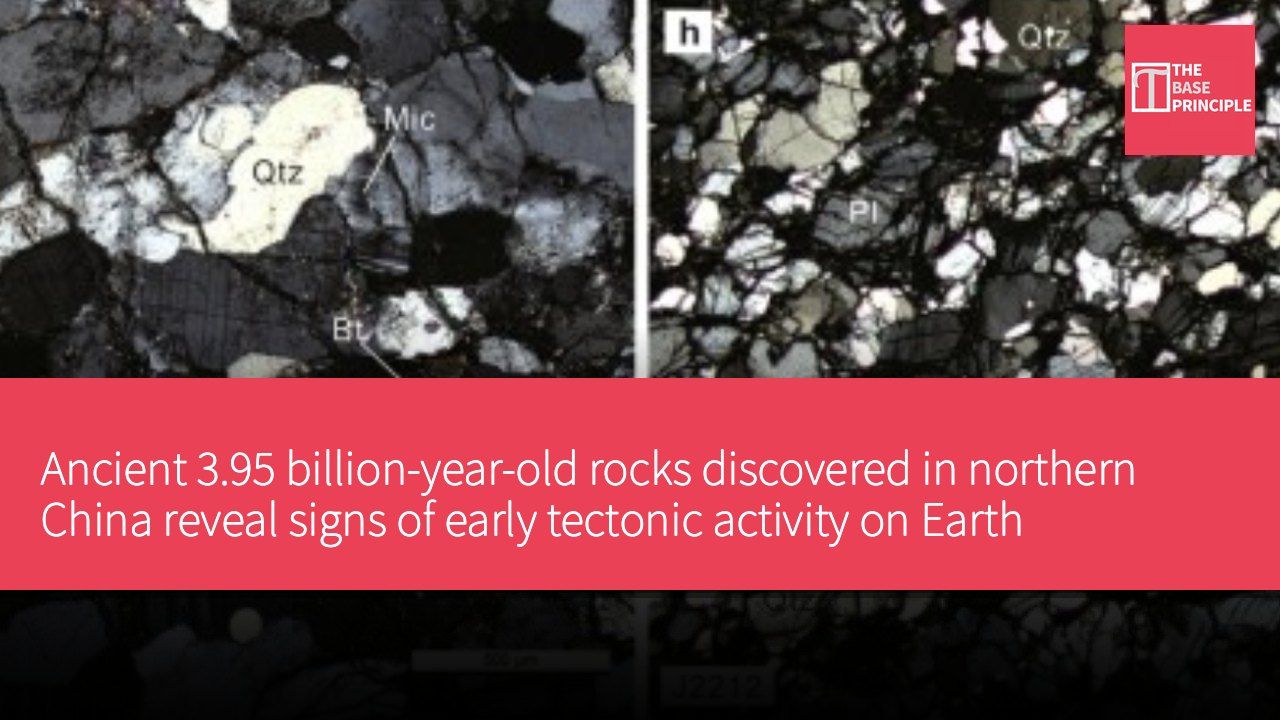
- 3.95 billion-year-old rocks discovered in northern China show evidence of early tectonic activity.
- These rocks provide new evidence of crust formation and subduction.
- The research indicates that the rocks originated from basaltic material altered at low temperatures.
- The latest study reveals evidence of early mantle and continental crust evolution on Earth.
Scientists have discovered rocks in northern China that are 3.95 billion years old, indicating tectonic activity from around 40 million years ago. The Earth formed approximately 4.5 billion years ago, but rocks older than 3.9 billion years are extremely rare. The research points out that rocks from this period have only been found in the Acasta Gneiss complex in Canada. A research team led by Professor Xie Hangqiang from the Chinese Academy of Geological Sciences identified 3.95 billion-year-old trondhjemitic gneiss in the North China Craton in eastern Hebei. These rocks contain chemical evidence showing that ancient oceanic crust was buried deep beneath the Earth's surface and subsequently partially melted.
Evidence of Crust Formation and Subduction
The team provided new evidence regarding the earliest crust formation on Earth and when it may have begun to subduct. Subduction refers to the process where a portion of the Earth's crust sinks beneath another, related to modern plate tectonics. This discovery adds to the evidence suggesting that the Earth's crust underwent complex geological changes during the planet's earliest history.
The team collected three samples from the Shimen complex for detailed analysis. Zircon contains uranium, which gradually decays into lead, allowing scientists to determine the age of the rocks. The research team also analyzed oxygen and hafnium isotopes in the crystals and used computer models to study their formation process. Researchers found that the zircon crystals had higher oxygen isotope values, averaging +6.77 ± 0.23 percent, along with positive hafnium isotope values. These chemical characteristics indicate that the rocks originated from basaltic material that had undergone low-temperature alteration. Hafnium measurements also showed that the source material was derived from a depleted mantle during the Earth's earliest geological era, the Hadean.
Researchers simulated the temperature and pressure conditions under which these rocks formed. Calculations indicated that the original magma formed through partial melting of basaltic crust at pressures exceeding 1.6 GPa and temperatures between 1364°F and 1508°F. However, according to the model, about 8% to 16% of the source material was melted. This material may have been brought to depths exceeding 30 miles below the Earth's surface before melting. Researchers stated that this subduction could explain how materials initially exposed to surface conditions reached such depths. "We propose that this rapid burial was likely achieved through a transient subduction event."
Early Evolution of the Mantle and Crust
The latest geological complex study provides evidence of the early evolution of the Earth's mantle and continental crust, offering new clues about the earliest crust on Earth. According to the research, hafnium isotope analysis indicates that material began to separate from the Earth's mantle to form new crust over 4.3 billion years ago. Researchers compared these findings with 4 billion-year-old rocks from the Acasta Gneiss complex in Canada, which previous studies showed formed under lower pressure conditions. In contrast, the Chinese rocks exhibited chemical characteristics consistent with formation under higher pressure.
Researchers proposed that a transient subduction event may have occurred around 3.95 billion years ago, providing new evidence of tectonic processes during the Earth's earliest history. The findings were recently published in the journal Nature.
Significance of Early Crustal Tectonic Activity
This discovery not only enhances the understanding of the Earth's early history but also illustrates the complexity of the crust formation process. By studying ancient rocks, scientists can trace geological changes on Earth, revealing the activities of early plate tectonics. This evidence is significant for understanding the evolution of the Earth and its tectonic dynamics, and it may influence future studies of other planets, especially in the search for celestial bodies with similar geological histories.