
- Neutrinos can traverse the universe but are difficult to detect, making them crucial for understanding the cosmos.
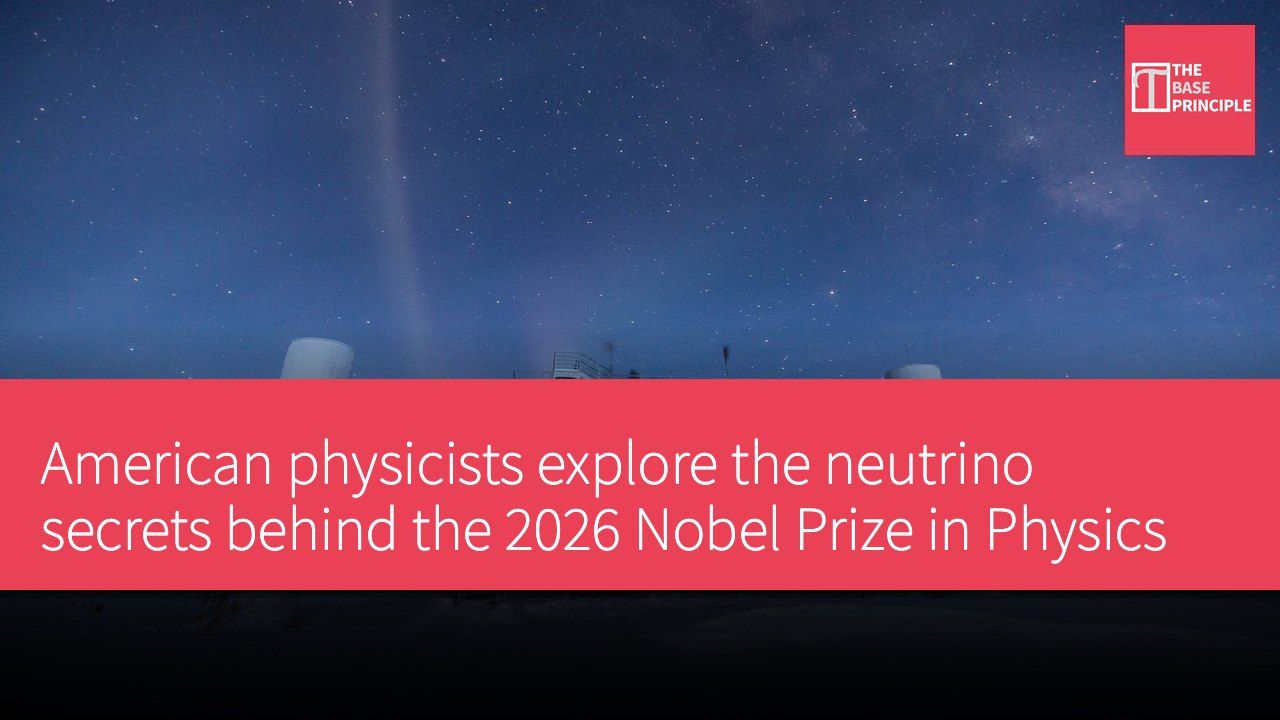
- The IceCube detector, located in Antarctica, uses the ice sheet to detect signs of neutrinos.
- Neutrinos can pass through extremely thick lead without stopping, showcasing their uniqueness.
- New discoveries may reveal more information about the Big Bang and the early universe.
American physicists have recently conducted in-depth research on the mysterious particles behind the 2026 Nobel Prize in Physics, explaining how these particles may help uncover some of the universe's significant secrets. George Fuller, a distinguished professor at the University of California, San Diego, collaborated with Dr. Francis Halzen on an early study involving the IceCube Neutrino Observatory. The Belgian-American physicist received this year's Nobel Prize in Physics for his work on the project.
Fuller has now revealed how these particles traverse the universe and why they are so difficult to detect. Approximately 100 billion neutrinos pass through every square centimeter of our bodies each second, with most leaving no trace. Fuller emphasized the importance of understanding neutrinos, stating, "Halzen's work, and the work of those inspired by his vision, provides humanity with a new window to observe the universe and its mysterious, elusive neutrinos."
How the IceCube Detector Works
The IceCube detector, which detects "ghost particles," is the world's largest neutrino detector, located near the Amundsen-Scott South Pole Station in Antarctica. It relies on thousands of light sensors buried in about 0.24 cubic miles (1 cubic kilometer) of ice to detect neutrinos. The observatory was developed based on Halzen's concept of building a detector deep in Antarctica, proposed in the 1990s. At that depth, fewer bubbles and impurities interfere with measurements. However, these elusive particles require extremely precise equipment to detect, as they interact very weakly with matter.
Thus, the site utilizes a vast amount of ice to capture their signatures.
When high-energy neutrinos collide with the ice, they release charged particles, producing faint blue flashes of light known as Cherenkov radiation. These flashes can determine the energy of the neutrinos and their direction of origin. However, high-energy cosmic neutrinos are extremely rare, with IceCube detecting only a few dozen each year. Some of these have energies 10 billion times greater than typical solar neutrinos. "One neutrino detected in a similar experiment had an energy 200 times higher than this," Fuller said. Even so, their origins remain unknown. "We don't really know where that neutrino came from," Fuller stated.
"The fact that it can reach here may be conveying some profound information about the universe to us."
The Uniqueness and Abundance of Neutrinos
As fundamental particles, neutrinos cannot be broken down into smaller components. There are three types of neutrinos: electron neutrinos, muon neutrinos, and tau neutrinos. Due to their minimal interaction with matter, they can travel vast distances in space at speeds close to that of light. "Neutrinos are actually ghostly particles," Fuller noted. "It's hard to stop them, hard to catch them. How do we know they exist, or where they are?" At the same time, their unique properties allow them to escape extreme conditions near collapsing stars and black holes. According to Fuller, neutrinos can even pass through light-years of lead without stopping, depending on their energy.
Despite being difficult to detect, these particles are extremely abundant. Estimates suggest that there are about a billion neutrinos for every atom in the universe. "In this sense, Halzen is indeed at the forefront of experimental particle physics," the physicist summarized in a press release. New discoveries may reveal more information about the Big Bang and the early universe. The University of California, San Diego is also involved in the Simons Observatory located in the Atacama Desert of Chile, which studies the cosmic microwave background, the oldest light in the universe, and may provide clues about ancient neutrinos.
Item Specification Neutrino Types Electron neutrinos, muon neutrinos, tau neutrinos Detection Energy Up to 200 times that of solar neutrinos IceCube Detector Volume About 0.24 cubic miles (1 cubic kilometer)
The Importance of Neutrino Research for Cosmic Exploration
As fundamental particles, neutrinos are significant for revealing the mysteries of the universe. Their unique properties, allowing them to survive in extreme environments and traverse matter, make them key to studying cosmic evolution and fundamental physics. The successful operation of the IceCube detector demonstrates scientists' efforts in exploring these mysterious particles and may provide new clues for understanding the Big Bang and the early universe. As research deepens, neutrinos may offer us more profound insights into the origins of the universe.