
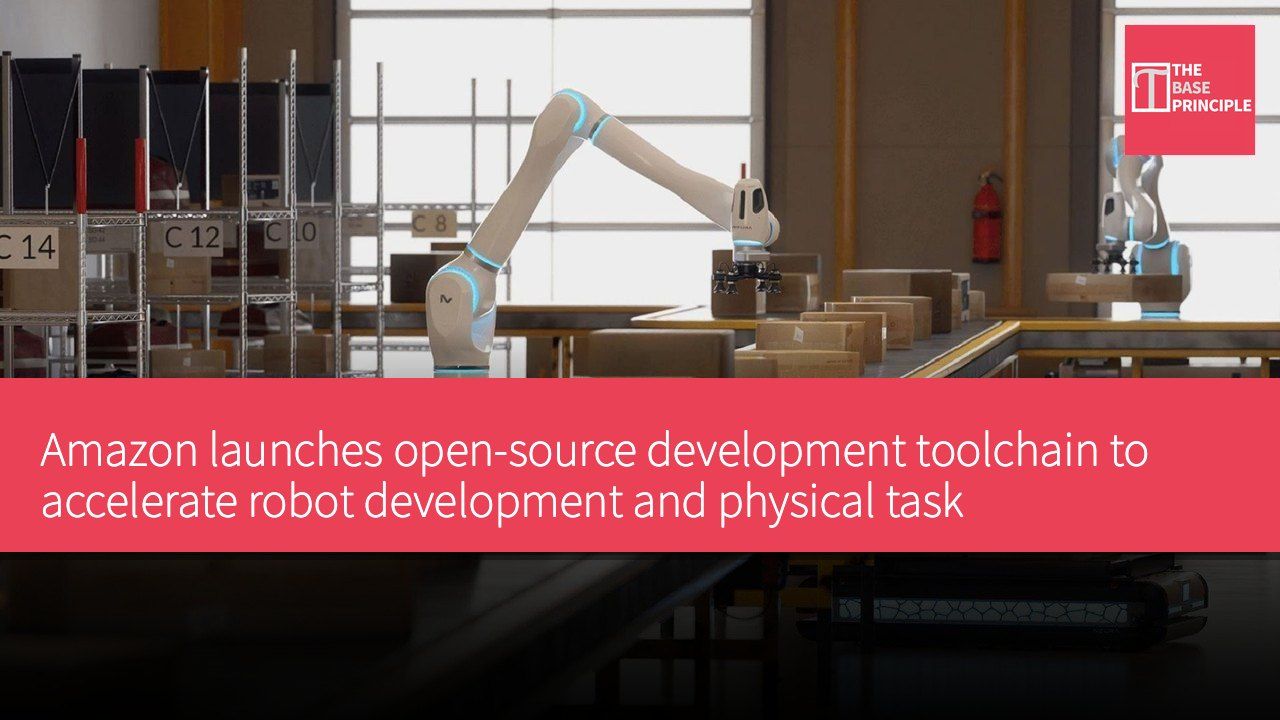
- Amazon launches open-source platform to support robot development and physical task implementation.
- The toolchain integrates multiple AWS and NVIDIA services, simplifying the development workflow.
- Physical AI enables robots to adapt to changing environments and learn from experience.
- The platform's success depends on effective transition from simulation to physical operation.
Amazon Web Services (AWS) has launched an open-source development platform to help enterprises build and deploy robots capable of perceiving their surroundings, making decisions, and executing physical tasks. Called the Physical AI Toolchain on AWS, the platform combines AWS infrastructure with NVIDIA's physical AI software ecosystem, aiming to support the development of industrial robots, autonomous mobile machines, and humanoid systems. Amazon says the toolchain aims to reduce the engineering effort required to move AI models from development to actual machines.
Shift in AI Development
The launch reflects a broader shift in AI development: from systems that generate text and images toward machines that must interact with physical environments, where errors can damage equipment, disrupt production, or create safety risks.
Traditional industrial robots typically perform pre-programmed actions in controlled environments. Physical AI aims to make machines more adaptable, enabling them to interpret sensor data, respond to changing conditions, and learn from experience. For example, a robot working on an assembly line may need to handle components presented at different angles, while an autonomous warehouse vehicle must navigate shifting layouts and avoid obstacles. Humanoid robots face an even broader challenge: manipulating unfamiliar objects and performing tasks in environments designed for humans. Training these systems requires more than a powerful AI model; developers also need large-scale training data, realistic simulation, compute resources, and a way to transfer trained models onto physical hardware.
AWS says the new toolchain integrates these elements into a common development workflow, letting enterprises choose a full-stack solution or pick individual components for existing projects.
Toolchain Architecture
The toolchain is organized around five parts of the physical AI development process. Synthetic data generation: AI-generated environments create additional training scenarios without recording every situation in the real world. Model training: systems learn from human demonstrations and simulated practice. Simulation and validation: developers test robot behavior in virtual environments before running on physical machines. Edge deployment: optimized AI models run on deployed hardware, enabling real-time decisions without continuous cloud connectivity. Continuous improvement: data collected during operation feeds back into training, helping developers refine models for future deployments.
The platform combines AWS services such as Amazon SageMaker for model training, Amazon EC2 GPU instances for simulation, AWS IoT Greengrass for edge deployment, and Amazon Bedrock AgentCore for orchestration. It also integrates NVIDIA tools including Isaac Sim for robot simulation, Isaac Lab for reinforcement learning, Isaac GR00T for humanoid robots, and Cosmos for generating synthetic environments.
The goal is to reduce friction between these stages. Engineering teams can use a shared architecture instead of independently assembling and maintaining every part of each development pipeline, adapting it to their own hardware and applications.
Amazon says the toolchain draws on its own robotics operations, with the company reporting more than one million robots across its network. That experience exposed the practical challenges of operating autonomous machines at scale, from fleet coordination to maintaining software on deployed hardware. The company highlighted several developers working on physical AI. NEURA Robotics is developing cognitive humanoid robots, RLWRLD is building foundation models for dexterous manipulation, and Config has built a pipeline for collecting and scaling robot action training data.
For manufacturers, potential applications range from robotic arms that adapt to new assembly tasks to autonomous machines that move materials and monitor production. However, the toolchain is a development platform, not a ready-made robot, and its availability does not guarantee that simulation-trained models will run reliably in a factory or warehouse.
Simulation-to-Reality Challenge
A core challenge in robotics is the transition from simulation to real-world operation. A model that succeeds in a virtual environment may encounter unexpected friction, lighting changes, sensor noise, or variations in object handling when deployed on physical hardware. By combining simulation, training, deployment, and feedback in a single workflow, AWS and NVIDIA aim to make that transition more manageable. The toolchain also includes fleet management capabilities designed to help enterprises provision, secure, and update machines as deployments grow. For engineers, the significance lies not only in any single new AI model, but in the infrastructure needed to develop physical AI systems repeatedly.
Item Specification Simulation Environment Synthetic Data Generation Learning Method Human Demonstration and Simulation Practice Testing Method Virtual Environment Testing Deployment Method Edge Deployment Data Feedback Continuous Improvement
Future Challenges and Opportunities in Physical AI Development
As robotics technology advances, enterprises increasingly need systems that can interact with physical environments. Amazon's open-source development platform not only provides the necessary tools but also addresses the challenges robots face in actual operation. This includes the transition from simulation to real-world operation, a critical technical challenge. Successful physical AI systems require large-scale training data and effective simulation environments to ensure reliability in the real world. Such development platforms help accelerate the progress of robotics technology and drive automation across industries.