
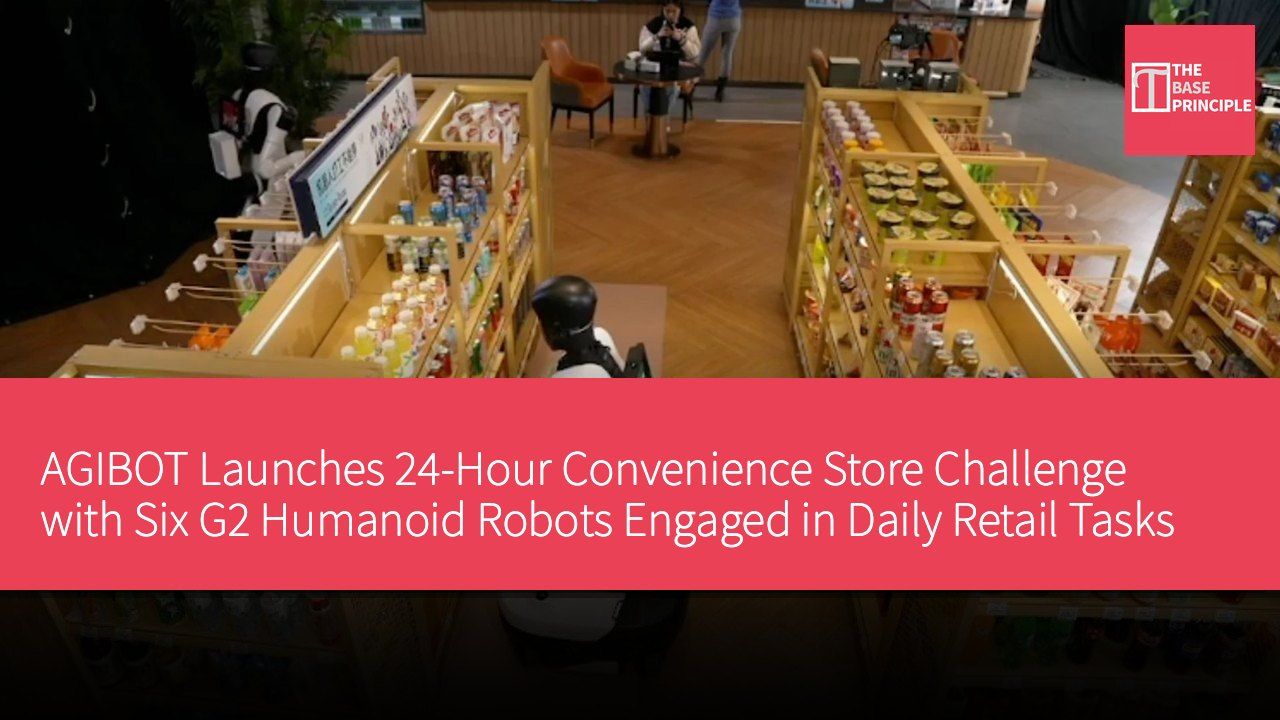
- AGIBOT launched a 24-hour convenience store challenge with six G2 robots participating.
- The challenge aims to test the robots' performance during peak hours and nighttime operations.
- The live event allows viewers to observe the interactions between robots and human customers.
- Experts emphasize that assessing the details of robot performance will be crucial.
Chinese robotics company AGIBOT has launched a 24-hour convenience store challenge, where six G2 humanoid robots work alongside human customers. The live event, titled "Robots Never Clock In," took place from November 2 to November 3, allowing viewers to gain deeper insights into the robots' performance in daily retail tasks. Their assigned tasks included restocking, making coffee and hot food, assisting customers, and cleaning up trash. According to the company, this challenge aims to test the robots' performance in various store environments, including customer traffic during peak hours, nighttime operations, and the breakfast rush in the morning.
AGIBOT deployed six G2 humanoid robots in the convenience store for a 24-hour challenge to showcase their ability to perform daily retail tasks. This event allowed viewers to see the robots working alongside human customers and staff in a real retail environment. The robots are expected to handle multiple tasks, including restocking and organizing shelves, making coffee and hot food, assisting customers, and cleaning up trash. AGIBOT divided the challenge into four operational periods: lunch peak, evening peak, overnight shift, and breakfast preparation.
Challenges Faced by the Robots
The live event is designed to expose the robots to different working conditions, from busy customer activity periods to nighttime operations and the breakfast rush. The convenience store environment combines multiple technical demands. The G2 robots must navigate shared spaces with humans, interact with products, reach for and manipulate items, and respond to customer requests while other activities are ongoing. These tasks require more than just basic mobility. Restocking involves locating products, reaching for individual items, and placing them in the correct position. Making coffee and hot food requires the robots to interact with equipment and objects in a controlled manner, while customer-facing duties include responding to requests and operating around others.
The different operational periods also introduce variations in the environment. During peak hours, the robots must work amidst increased customer activity and potentially obstructed pathways. Nighttime operations present different conditions, while breakfast preparation introduces another set of tasks. The 24-hour live stream provides a longer observation window than short demonstrations, allowing viewers to see not only successful task completions but also potential pauses, repeated attempts, and recovery from difficulties. For instance, an item may be difficult to grasp, a customer may block the robot's path, or sudden requests may interrupt ongoing tasks.
The robots' responses to these situations may reveal their actual capabilities more than isolated action demonstrations.
Key Factors in Assessing Robot Performance
This challenge coincides with AGIBOT's AI Day announcement, which includes new AI models, the G2 Max robot, and proposed Worken productivity metrics. The company presents the convenience store activity as a practical demonstration of its technology working in everyday environments. However, the announced 24-hour duration refers only to the live stream and does not indicate that each robot can operate continuously without needing to recharge, maintenance, or human assistance. The promotional materials reviewed also did not clearly outline a complete intervention policy or scoring system for measuring task success.
Experts point out that these details will be crucial in assessing robot performance. The number of completed tasks, the time taken for each activity, the frequency of human intervention, and the ability to recover from unsuccessful attempts will provide useful performance metrics.
Currently, this live stream offers viewers an extended opportunity to observe six G2 robots engaging in multiple retail activities in a shared environment. This may provide a more detailed picture of how humanoid robots handle routine work, rather than just controlled demonstrations, although the duration of the event itself does not prove fully autonomous, continuous operation.
Practical Significance and Challenges of the Live Event
AGIBOT's 24-hour live event not only showcases the G2 robots' ability to perform daily retail tasks but also provides a long-term observation opportunity. Through the challenges of different operational periods, viewers can see the robots' performance in real environments, including their ability to respond to customer requests and handle unexpected situations. These factors are crucial for assessing the robots' practical application potential, as they reflect the robots' adaptability and efficiency in everyday work.