
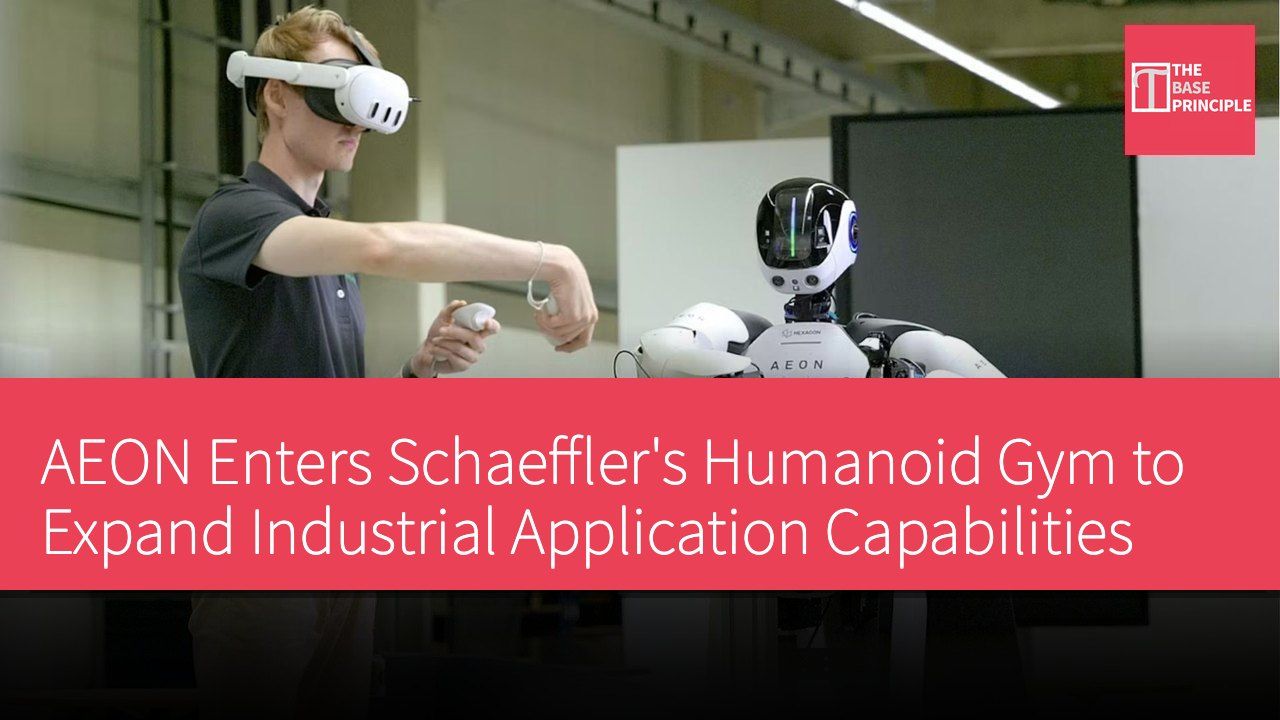
- AEON has entered Schaeffler's Humanoid Gym to advance industrial applications.
- The deployment of the Humanoid Gym follows a train-validate-deploy model.
- The collaboration aims to deploy at least 1,000 humanoid robots, requiring skilled personnel.
- Work within the gym will develop internal expertise alongside AEON's capabilities.
Hexagon Robotics and motion technology company Schaeffler announced last month that AEON has entered Schaeffler's Humanoid Gym in Germany, a collaboration that advances the introduction of humanoid robots into industrial settings. The facility will be used to teach AEON new manufacturing capabilities, validate what it has learned, and prepare the robot for deployment. The partners are committed to deploying at least 1,000 AEON humanoid robots in the coming years. By placing the robot in an industrial training environment, both parties can develop its capabilities while Schaeffler builds the knowledge needed to introduce humanoid robots.
The Deployment Model of the Humanoid Gym
The industrial deployment path of the Humanoid Gym is divided into three phases, following a train-validate-deploy model. Each capability is first taught to AEON, then assessed, and subsequently prepared for application in an industrial environment. This structure provides a clear process for companies to transfer capabilities from training to actual deployment. It creates a dedicated space where, as the collaboration progresses, the robot can be prepared for manufacturing work. The facility also serves a second purpose, as Schaeffler will use the program to develop its expertise in operating, training, and integrating humanoid robots.
These three areas address different parts of the adoption process, with AEON needing to acquire the necessary industrial capabilities and Schaeffler's team needing to master the knowledge to manage the robots and integrate them into the company's manufacturing environment. Therefore, the gym supports the development of both the technology and the organization that will utilize it.
The Scale and Challenges of the Collaboration
AEON's entry into the Humanoid Gym marks the next stage of the strategic collaboration between Hexagon Robotics and Schaeffler. Their plan is to deploy at least 1,000 humanoid robots, although the partners have not disclosed the timeline for individual deployments. They have also not specified which industrial capabilities AEON will learn first or what initial manufacturing tasks it will undertake. Currently, the gym has established a process for developing and testing these capabilities. The scale of the plan means that Schaeffler must prepare not just the robots themselves, but also skilled personnel to train the humanoid robots, oversee their operation, and integrate them into industrial processes.
The work within the gym will allow internal expertise and AEON's capabilities to develop in parallel. As a result, the partners can prepare for deployment through a shared program rather than treating robot training and organizational preparation as separate tasks.
This milestone does not mean that the planned fleet is already in service, but rather marks the beginning of the industrial preparation that will support future deployments. The collaboration aims to accelerate the adoption of next-generation automation in manufacturing. AEON's entry into the gym provides both parties with an industrial environment for training and validation to prepare for deployment. It also allows Schaeffler to build practical expertise before scaling up the planned number of humanoid robots. The work completed in the coming years will underpin the partners' efforts to transition AEON from capability development to industrial operation.
The Impact of Humanoid Robots on Industrial Automation
AEON's entry into Schaeffler's Humanoid Gym demonstrates the potential of humanoid robots in industrial automation. Through a phased approach of training and validation, this collaboration not only enhances the robot's technical capabilities but also emphasizes the importance of personnel skills. As the plan progresses, companies must balance the integration of robot technology with human resources to ensure successful deployment. Such a collaborative model may become the standard for future industrial automation, driving the industry towards more efficient production methods.