
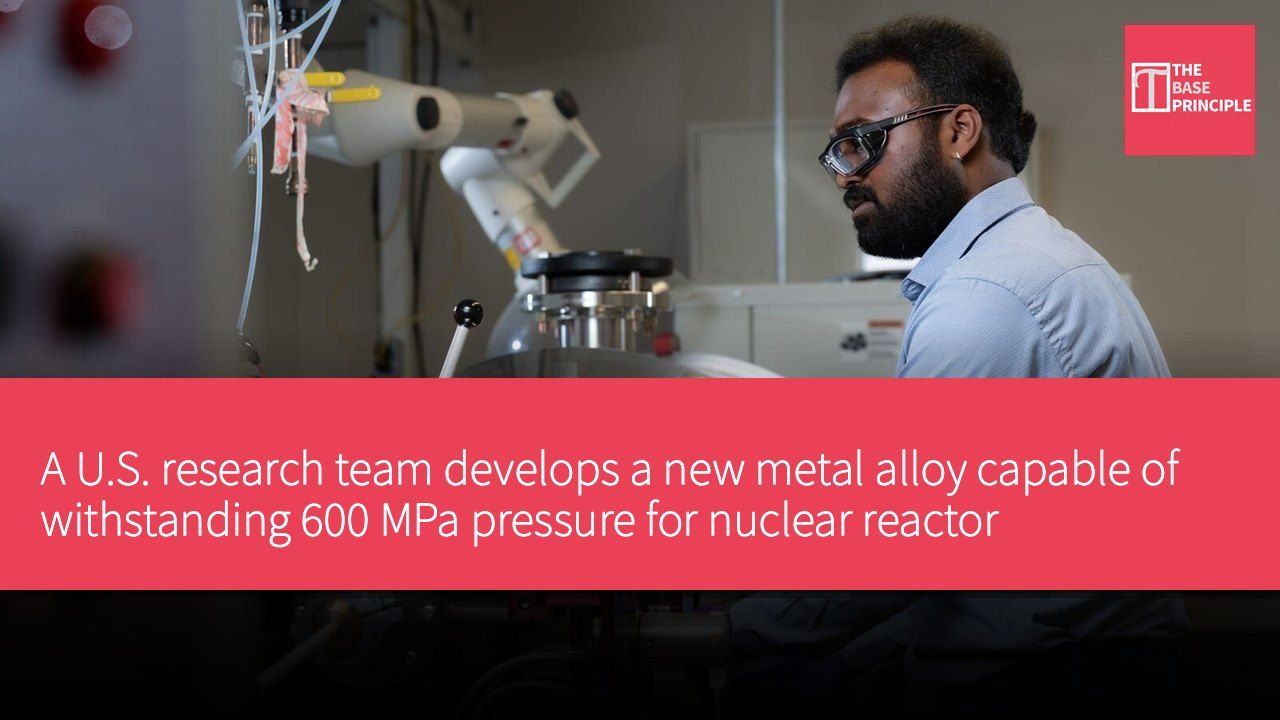
- The new metal alloy V555 can withstand 600 MPa pressure at room temperature.
- The alloy is specifically designed for nuclear fission reactors and has completed preliminary testing.
- The research team developed a robust eight-step alloy design process to screen materials.
- The V555 material can be recycled to reduce waste during the experimental process.
A U.S. research group has developed a new metal alloy that can withstand pressures of up to 600 megapascals (MPa) at room temperature, specifically designed for nuclear fission reactors. This experimental alloy, named V555, was developed by the Pacific Northwest National Laboratory (PNNL) of the U.S. Department of Energy (DOE). After evaluating nearly 1,000 potential metal combinations, scientists identified the most promising new alloy formulation. To rapidly screen, simulate, and optimize materials, the researchers employed a computational method known as Robust Alloy Design (RAD).
This method can identify materials capable of withstanding extreme temperatures, radiation, and mechanical stress within a nuclear reactor. PNNL stated that the alloy has already completed preliminary room temperature testing.
Design and Development of the New Alloy
Dr. Osman El Atwani, a materials scientist and research lead, stated, "This work provides a pathway for the nuclear materials community to explore and evaluate a broader range of materials for future nuclear systems." Traditional cladding materials include steel and zirconium-based alloys, such as Zircaloy. However, according to El Atwani, new alloys derived from various primary elements may exhibit better properties by altering their metallic composition. To select different elements and create entirely new combinations, he and his team developed an eight-step RAD process.
The process evaluates potential materials based on several criteria, such as radiation resistance and manufacturability.
Mohan Nartu, a materials scientist at the Pacific Northwest National Laboratory, used an arc melting machine to create samples of the new alloy named V555. The team initially relied on this method to identify about 724 potential alloy combinations. They then turned to the RAD scoring system to narrow down their options. This assessment tool ranks alloys based on their suitability for nuclear reactors. Ultimately, the team selected V555 for preliminary laboratory testing to validate the feasibility of the computational method in practice. Dr. Nartu revealed, "The standard practice is to swap this element with that one and swap that element with this one."
“While this technically produces new materials, it does not fundamentally change the basic composition, so the inherent properties of the materials remain.”
Performance Testing Results of V555
After selecting V555, the team produced samples to test their structure and strength. To their surprise, preliminary room temperature tests indicated that the alloy has a yield strength of approximately 500 to 600 MPa, which refers to the amount of stress the material can withstand before beginning to deform permanently. Although initial results show the alloy's strength, further testing is needed to confirm its suitability for nuclear reactors. The team also found that unused V555 material can be recycled to produce additional samples without compromising its quality, helping to reduce material waste during experimental testing.
Researchers will further examine V555's performance under thermal, radiation, and other reactor conditions, and test other combinations identified through the RAD process. This research is supported by the DOE's Office of Nuclear Energy through its Innovative Nuclear Materials Program. Nartu summarized in a press release, "We hope to demonstrate that if you have the right criteria, you can start from scratch in selecting elements and systematically design materials suitable for nuclear applications." The study has been published in the journal Materials and Design.
Impact of New Material Design on Nuclear Energy Applications
The development of the V555 alloy represents a significant advancement in nuclear materials research, as its design focuses on addressing the extreme environments of nuclear reactors. Through the Robust Alloy Design process, the research team was able to systematically explore different metal combinations, which is crucial for material selection in future nuclear systems. As further testing of V555 progresses, if it performs well in nuclear reactors, it could potentially replace traditional cladding materials currently in use, enhancing the safety and efficiency of nuclear energy. Additionally, the recyclability of the material also contributes to reducing resource waste, aligning with sustainability goals.