
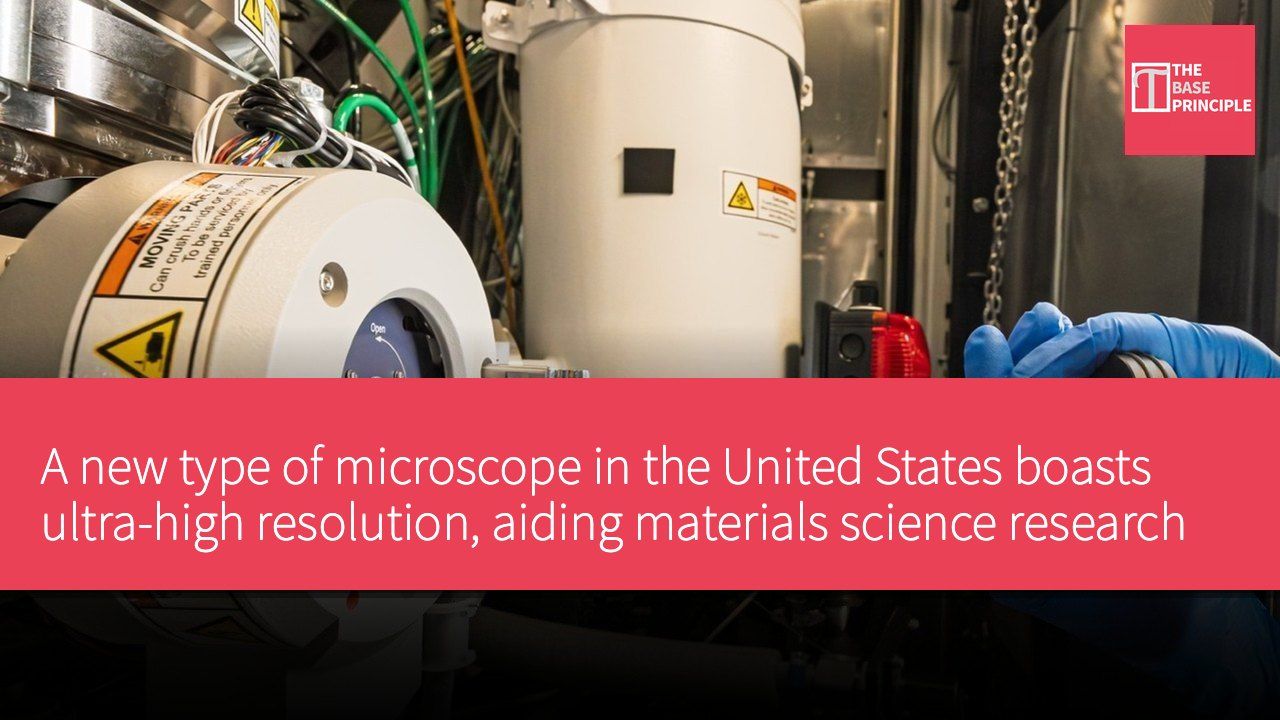
- The new microscope can distinguish individual atoms with a resolution of less than 0.05 nanometers.
- The microscope supports the development of stronger metal alloys and permanent magnets.
- Future upgrades may incorporate artificial intelligence automation to enhance data collection efficiency.
- The technology can identify material patterns, accelerating research progress and tracking material changes.
A powerful microscope recently installed in the United States reportedly can distinguish individual atoms with exceptional spatial resolution of less than 0.05 nanometers (nm). This advanced scanning transmission electron microscope (STEM), named Thermo Scientific Spectra Ultra, is located at the Oak Ridge National Laboratory (ORNL) of the U.S. Department of Energy in Tennessee. It is one of the most advanced microscopes in the U.S. national laboratories, designed to accelerate material searches and integrate atomic-level imaging, high-speed spectroscopy, and super-intelligent (SI) driven workflows.
ORNL revealed that this microscope can support the development of stronger metal alloys, permanent magnets, and industrial catalysts.
Applications and Impact of the Microscope
Dr. Allen Haynes, director of the U.S. Department of Energy's Powertrain Materials Consortium, stated, "With this new microscope, we can examine specific atomic structures that affect material strength and stability, helping to reveal why one lightweight alloy maintains its strength after years of vibration, heat, and pressure, while another begins to weaken." The microscope's spatial resolution of less than 0.05 nanometers means it can distinguish individual atoms. At the same time, it can examine the atomic structure of materials while collecting detailed information about their chemical composition.
According to Haynes, these insights are crucial for material development.
"These insights help guide the development of lighter, stronger, and more stable alloys for future transportation applications," he noted, which could pave the way for lighter vehicles. The microscope can also improve permanent magnets used in electric motors. For example, it can reveal how key minerals are arranged within the magnets and help identify heat-resistant alternatives. Haynes explained that this instrument could also extend the lifespan of catalysts used in fuel cells, chemical manufacturing, and fertilizer production. "These capabilities allow scientists to gain deeper insights into how materials work and the knowledge needed to develop superior new materials for next-generation technologies."
Researchers stated.
Prospects for Automated Workflows
According to scientists, future upgrades may also bring artificial intelligence automation to the instrument. To this end, the team has begun developing automated workflows capable of collecting and testing larger volumes of data without inspecting each sample individually. "The automation component will provide researchers with larger datasets that can more clearly reveal the underlying nanostructures that determine the performance and durability of advanced materials," said Dr. David Cullen, a member of ORNL's Applied Microanalysis and Thermophysics group.
This technology can identify important patterns in materials and help accelerate research progress. "It's all about improving output efficiency," Cullen shared in a press release. "We are developing automated microscopy methods to increase the speed at which we generate scientific understanding." Additionally, this new microscope can help the team track changes in materials over time and discover potential defects. "For automotive manufacturers, there has long been a search for lighter metals to improve fuel efficiency and driving range without sacrificing safety or durability," the group concluded, "achieving this balance requires understanding how materials change over many years of actual use."
Revolutionary Impact of the New Microscope on Materials Science
The launch of this new microscope marks a significant advancement in materials science research. Its ultra-high resolution allows scientists to gain deeper insights into the atomic structure of materials, which is crucial for developing new alloys and improving industrial catalysts. With the introduction of artificial intelligence automation, future research will be able to collect and analyze data more efficiently, further enhancing material performance. This could not only improve the design of vehicles and electric motors but may also have a profound impact on other industries such as chemical manufacturing and energy production.