
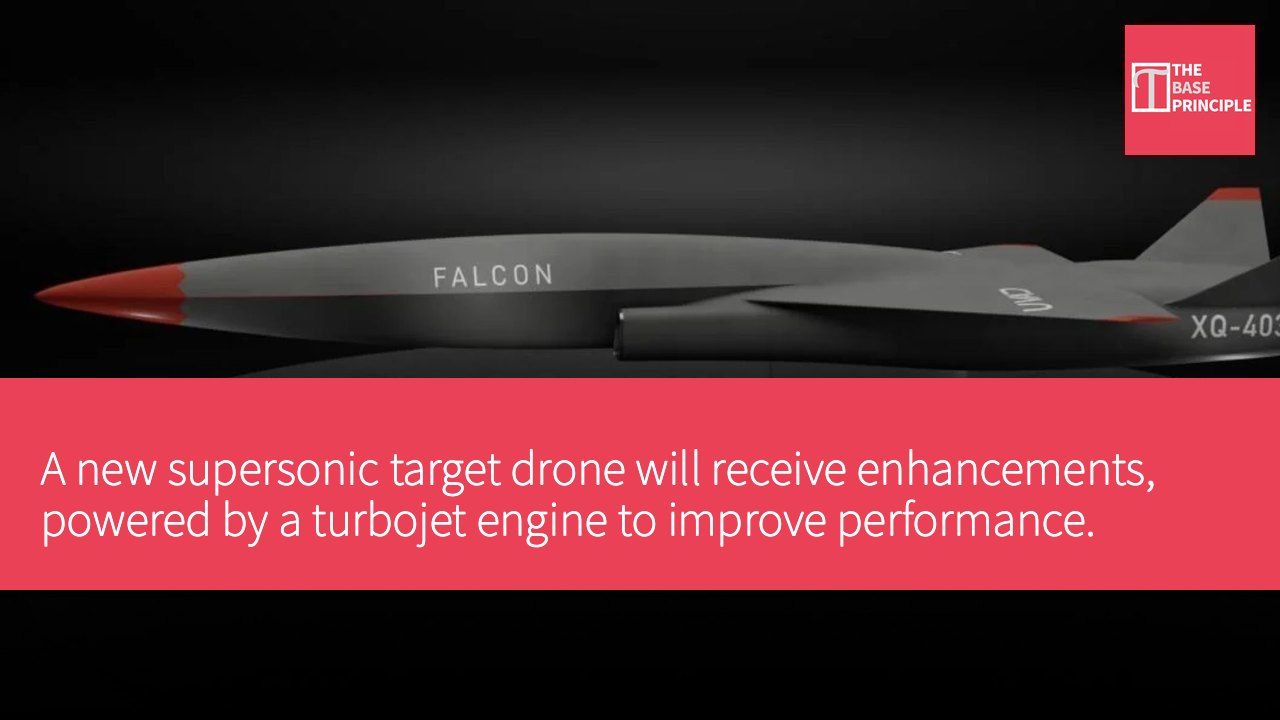
- The Falcon supersonic drone will be equipped with a turbojet engine to enhance performance.
- The drone can be used for high-speed intelligence, surveillance, and reconnaissance missions.
- Falcon features a modular architecture that can adapt to changing operational environments.
- The advanced autonomous flight system can control multiple drones simultaneously, improving mission efficiency.
A new supersonic target drone is set to receive significant upgrades, thanks to the support of a turbojet engine. Texas-based Safran Power Units will provide its turbojet engine for this supersonic target drone. The drone, named the Falcon supersonic UAV, is developed by UVAD Technologies Inc. UVAD claims that as a multipurpose platform, the Falcon can serve as an entry-level counter-hypersonic system and can be used for high-speed intelligence, surveillance, and reconnaissance (ISR), or operate as an interceptor, and can work alongside fighter jets as a disposable high-speed drone.
The Falcon will be powered by two turbojet engines provided by Safran Power Units, which offer strong reliability and extended service life, far exceeding current industry standards. The engines from Safran Power Units will enable the Falcon to achieve supersonic speeds at low to medium altitudes while ensuring rapid deployment and recovery. According to a press release, this level of performance allows air, naval, and missile defense operators to conduct more frequent and cost-effective training.
Multipurpose Capabilities of the Falcon
David Birkett, CEO of UVAD Technologies Inc., stated, "We are particularly excited to partner with Safran Power Units, a company with a global reputation for high-performance and affordable turbojet engines. Our two companies share a common vision for high-performance, cost-effective defense systems that can meet future challenges, especially those posed by hypersonic threats." This strategic partnership combines UVAD's innovations in aerospace and defense with Safran Power Units' global leadership in propulsion technology.
In addition to meeting current training needs, this partnership anticipates future challenges, providing armed forces with an adaptable solution. The Falcon features a modular architecture and autonomous flight system, embodying the shared vision of Safran Power Units and UVAD to make advanced defense technologies more accessible and adaptable to changing operational environments. According to the press release, this innovative system will allow a single operator to monitor multiple drones simultaneously, optimizing the efficiency and flexibility of training scenarios.
Advantages of the Autonomous Flight System
Ghislaine Doukhan, CEO of Safran Power Units, stated, "We are very pleased to begin this partnership with UVAD to provide propulsion systems for its Falcon drone. The choice of our engines will significantly contribute to the Falcon's capabilities in supersonic flight, reliability, and cost-effectiveness." According to company information, the Falcon's supersonic speed, aerodynamic design, and high maneuverability enable it to perform complex flight patterns and evasive maneuvers, making it a powerful asset in training scenarios and actual operational deployments.
The drone is equipped with an advanced autonomous flight system that allows operators to control multiple units simultaneously, enhancing mission efficiency and reducing manpower requirements. UVAD also emphasizes that the Falcon's container design facilitates transport and setup, while the aerodynamic catapult launch system eliminates the need for runways, maximizing mission flexibility in dynamic environments. The drone has a speed of 1.6 Mach and a payload capacity of 110 pounds.
The Impact of the Falcon Drone on Modern Military Training
The launch of the Falcon supersonic drone marks a significant transformation in military training methods. With the application of turbojet engines, this drone not only enhances performance but also makes training more cost-effective and flexible. Its modular design and integration of the autonomous flight system allow operators to manage multiple drones simultaneously, which is particularly important in modern military operations as it can adapt to changing battlefield environments. This innovation not only meets current needs but also provides an adjustable solution for future defense challenges.