
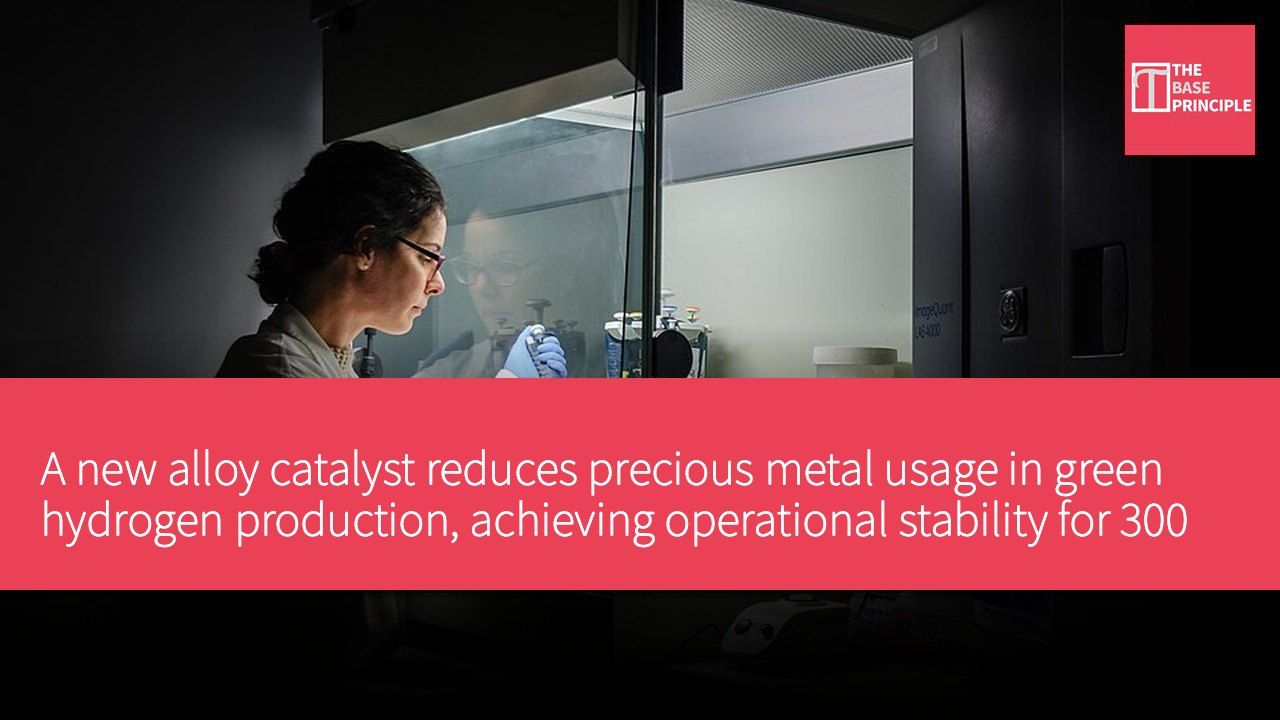
- The new catalyst reduces the use of precious metals in green hydrogen production.
- The catalyst has demonstrated stable operation for over 300 hours, outperforming commercial benchmarks.
- The precious metal content of the alloy catalyst is only half that of the commercial benchmark.
- Research shows that the medium-entropy alloy can overcome the trade-off between activity and stability.
Researchers in Braga, Portugal, have developed a novel catalyst that could reduce the amount of precious metals required for green hydrogen production. The material outperforms commercial benchmarks, despite having only half the precious metal content of those benchmarks. The team from the International Iberian Nanotechnology Laboratory (INL) synthesized platinum, nickel, and ruthenium into an alloy specifically designed for proton exchange membrane water electrolysis (PEMWE). The research report indicates that the unit operated stably for over 300 hours at 60 °C (140°F). This finding addresses a challenge in electrolyzers: reducing reliance on expensive materials while maintaining performance.
Catalyst Performance Exceeds Benchmark
PEMWE utilizes electricity to split water into hydrogen and oxygen. Driven by renewable electricity, this provides a pathway for green hydrogen production. However, the hydrogen generation reaction at the cathode largely depends on scarce platinum group metals. The Kolen’ko research group at INL used a continuous flow synthesis reactor to produce nanoparticles of the medium-entropy alloy of platinum-nickel-ruthenium. These particles have a diameter of only 1.5 nanometers and are uniformly anchored on defect-rich graphene. The catalyst has a precious metal content of 20.5%, compared to a platinum content of 40% in commercial benchmarks, demonstrating significant advantages.
Despite the lower precious metal content, its performance still exceeds the benchmarks in multiple measurements.
In a single-cell PEMWE device, the catalyst achieved a current density of 1.0 ampere per square centimeter at 1.6 volts. The operational behavior of the catalyst is crucial to its performance. Initially, nickel oxide species cover the surface of the particles. After cathodic polarization, these oxides are reduced, exposing the surface of the metal alloy. Sitaramanjaneya Mouli Thalluri, the corresponding author of the study, stated, "The catalyst does not degrade; it activates, which is counterintuitive and is precisely the characteristic needed for long-term operation." Synchrotron X-ray absorption spectroscopy confirmed that the surface reconstruction is driven by electrochemistry.
At the typical industrial operating temperature of 60 °C (140°F), the unit maintained a stable voltage for over 300 hours. In contrast, the commercial benchmark exhibited ongoing performance degradation during testing.
Production Process Potential of the Alloy
These results indicate that changes in the surface of the alloy can support sustained activity, addressing the challenge of enhancing catalytic performance without compromising stability. The researchers also highlighted the potential of the production process. Combining metals with significantly different reduction potentials is challenging, as their formation must be coordinated to yield the desired alloy. Co-corresponding author Srinivas Katam remarked, "Continuous flow synthesis is a game changer here." The team noted that the reactor synchronizes the nucleation of metals, providing a pathway for large-scale production.
Dr. Yury V. Kolen’ko, head of the Kolen’ko research group at INL, stated, "This work demonstrates that medium-entropy alloys can overcome the traditional trade-off between activity and stability when produced via continuous flow synthesis." The researchers also see potential applications for this technology beyond hydrogen production, including other electrochemical energy conversion technologies. The research has received funding from the Portuguese Recovery and Resilience Plan (PRR) under the NextGenerationEU framework, through the Moving2Neutrality innovation agreement.
The results from the single cell lay the groundwork for further development of large-scale electrolyzer systems, where reducing precious metal demand while maintaining durability remains a key objective. The study has been published in the Chemical Engineering Journal.
Impact of the New Catalyst on Green Hydrogen Production
As the demand for renewable energy increases, the production of green hydrogen has become an important area of research. The development of this new catalyst not only reduces reliance on scarce precious metals but also achieves new heights in stability and performance. This has significant implications for the future large-scale production of green hydrogen, as it can lower production costs and enhance efficiency. Furthermore, the potential applications of this technology may extend to other electrochemical energy conversion technologies, further advancing the development of sustainable energy.