
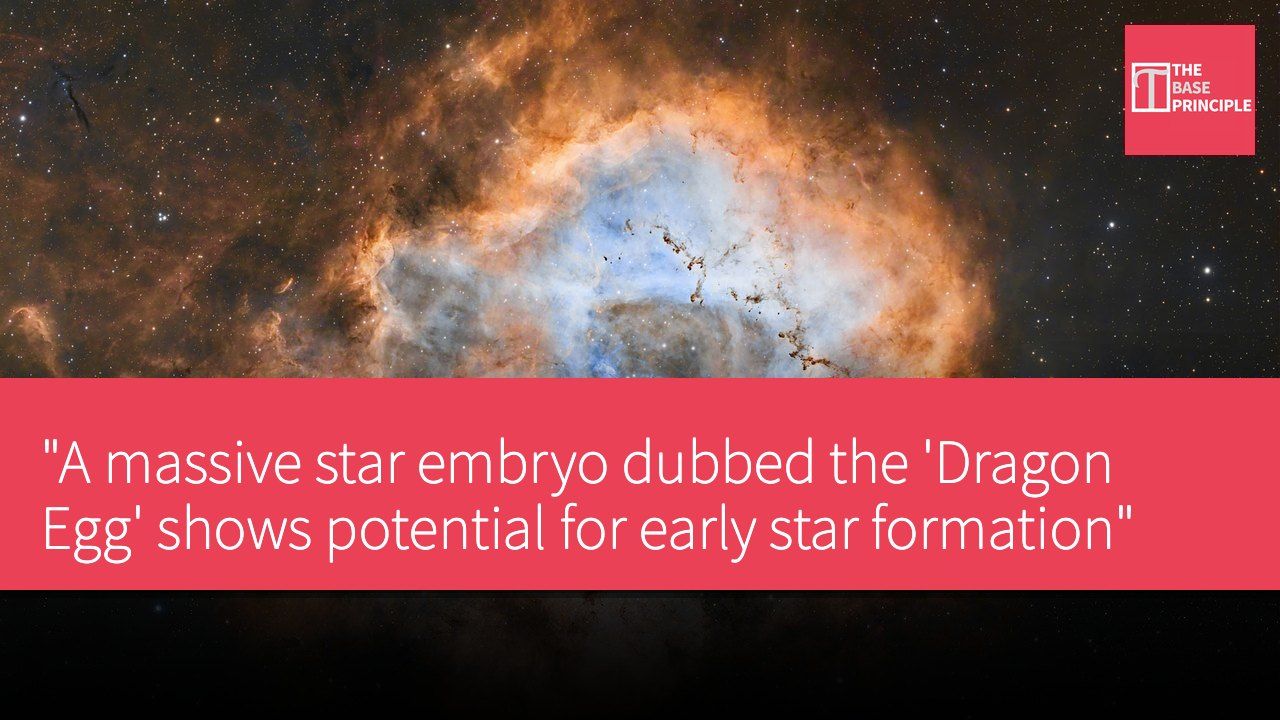
- The Dragon Egg is a possible massive star embryo that shows potential for early star formation.
- Researchers are exploring two theories: giant core collapse or small seeds growing by attracting surrounding material.
- Observations of C2c1a reveal its structure and lack of significant thermal gas outflow.
- The mass of the Dragon Egg and whether it has formed a protostar remain uncertain.
A possible massive star embryo exhibits striking characteristics, including an extremely compact core, a substantial reserve of cold gas and dust, and a lack of significant signs of energy outflow. This celestial object, nicknamed the "Dragon Egg," may provide a rare perspective on how massive stars begin to form. Researchers describe it in their study as "a promising compact high-mass core candidate." However, astronomers are still unable to determine how much mass is concentrated in its small core or whether a protostar has already formed. This makes the object particularly intriguing, as scientists continue to debate how stars with masses at least eight times that of the Sun form.
Two Theories of Star Formation
One theory suggests that a massive core forms first and then collapses into a star; the other posits that smaller seeds grow by attracting material from the surrounding cloud. By revealing the structure of a potentially early-stage object, the Dragon Egg aids researchers in investigating these competing theories.
The Dragon Egg, designated as C2c1a, is located in an infrared dark cloud known as the Dragon Nebula, approximately 16,300 light-years from Earth. Its parent clump contains about 1,061 solar masses, but it emits relatively little energy for its mass, indicating that it may be in the early stages of massive star formation. Early observations suggest that C2c1a contains between 20 and 30 solar masses, but the concentration of this mass or whether a protostar has formed remains undetermined. To investigate, a team led by Ashley Thomas Barnes at the European Southern Observatory used the Atacama Large Millimeter/submillimeter Array (ALMA) to observe the region at a wavelength of 1.3 millimeters.
The new observations revealed six components: the brightest source C2c1a(a), another significant part C2c1b, and four dimmer structures. Unlike the surrounding area, C2c1a(a) remains a single compact source, with an estimated radius of about 87 astronomical units (AU). An astronomical unit is the average distance between the Earth and the Sun. No smaller fragments were detected within the observational resolution limit of about 175 AU.
"The region is resolved into multiple fragments, but the brightest component C2c1a(a) remains a single compact continuous peak up to about 175 AU," the study authors noted. The brightness temperature of this compact source is about 40 Kelvin, while the gas temperature inferred from previous observations is about 10 Kelvin. This discrepancy indicates a strong temperature gradient, with the inner region being warmer, embedded within cooler material. However, the compact source is located within a larger reservoir that contains about 110 solar masses of gas and dust, spanning approximately 10,000 AU.
Some of this material may eventually supply the developing object, although the observations did not determine how much material would do so.
The Significance of the Lack of Outflow
Researchers searched for potential thermal gas emissions that might indicate a forming star, as well as outflows typically driven by young stars. They found no strong thermal gas signals at the center and did not observe significant high-velocity outflows associated with the compact source. "A weak, deeply buried, or poorly observable outflow cannot be ruled out, but the current data do not show clear outflow features from this compact source," the study authors stated. Some weak molecular emissions exist, but they are distributed throughout the region rather than concentrated at the center. The source may be cold, or thick dust may obscure the warmer material inside.
The lack of clear outflow does not rule out the possibility of a young star: weak, deeply buried, or poorly observable outflows may evade detection. The mass of the core also remains uncertain. Based on assumptions about the dust temperature and how it radiates, estimates range from about two to 30 solar masses. It could be a massive cold core or a warmer, lower-mass object surrounded by a larger reservoir.
The compact structure and lack of clear stellar activity align with previous star formation models, which suggest that a massive core forms before collapsing into a star. However, the observations do not exclude the possibility of smaller seeds growing by accumulating surrounding material. More detailed measurements of dust temperature, internal structure, and gas motion are needed to determine the contents of the Dragon Egg. Currently, ALMA has revealed an extremely compact source within a massive cold reservoir, but the key question of how the central object will grow remains unanswered. This research has been published in the arXiv academic journal.
How Observations of the Dragon Egg Impact Star Formation Theories
The discovery of the Dragon Egg provides astronomers with important clues for studying massive star formation. The structure and characteristics of this object support the previous theory that a massive core may exist before a star forms. However, the lack of obvious thermal gas outflow and stellar activity may also suggest the possibility of other formation mechanisms. These observations not only challenge traditional star formation models but also underscore the need for further research to deepen our understanding of the star formation process and its early-stage characteristics.