
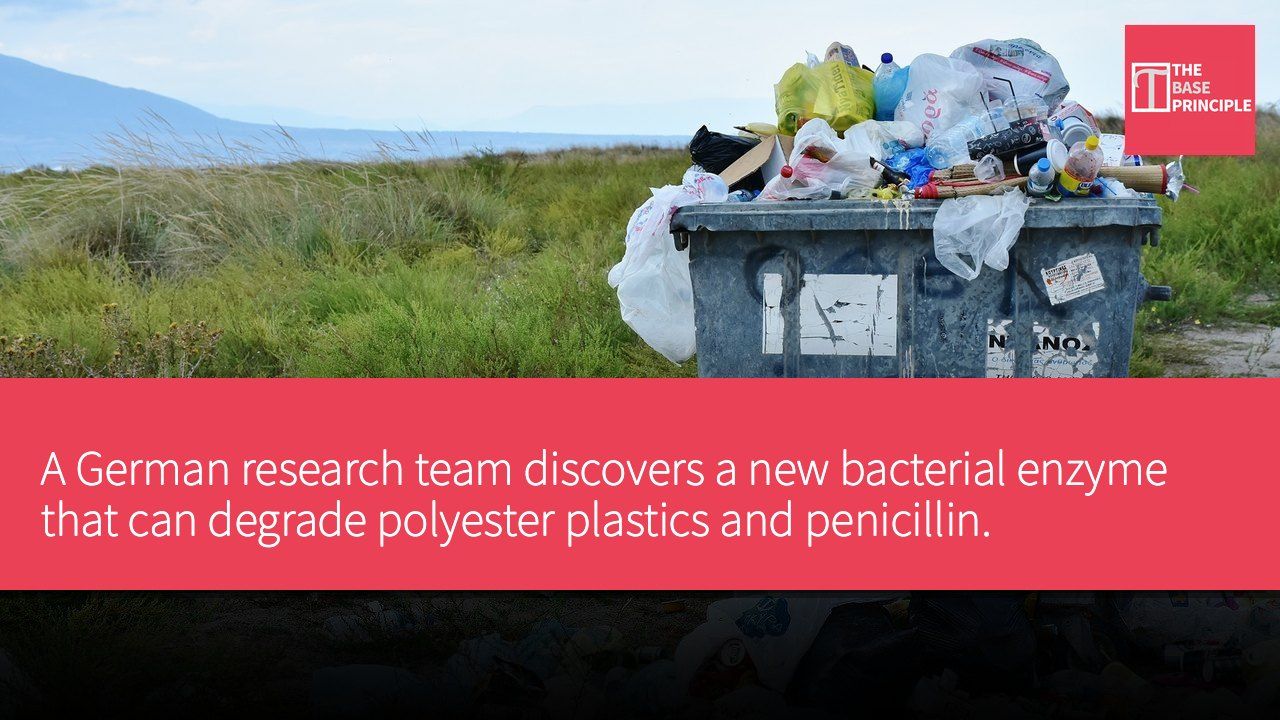
- The new bacterial enzyme can degrade polyester plastics and penicillin, demonstrating strong microbial adaptability.
- Most synthetic plastics degrade slowly, forming microplastics and nanoplastics.
- The research found that bacteria can invade plastic films through digestion, challenging traditional assumptions.
- Bacteria may evolve dual functions that assist in plastic degradation and antibiotic inactivation.
The research team at the University of Konstanz has discovered a novel bacterial enzyme capable of degrading certain polyester plastics and bioplastics, as well as cutting penicillin. This finding indicates that microorganisms may adapt to plastics more quickly than scientists had anticipated. The study was published in the ISME Journal. The enzyme is located on the exterior of bacterial cells and features an unusually large active site, which microbiologists Harry Lerner and David Schleheck have dubbed the "Pac-Man enzyme." Lerner is the first author of the study and was a postdoctoral researcher at the university at the time.
The significance of this discovery lies in the fact that most synthetic plastics degrade very slowly by microorganisms, leading to waste primarily breaking down into microplastics and nanoplastics. The biodegradation of high-density polyethylene (HDPE) could take hundreds to thousands of years. While microorganisms do colonize plastic waste, creating habitats referred to by researchers as "plastisphere," they typically cannot utilize most plastics as food.
How Bacteria Degrade Bioplastics
Over the course of a year in forest soil, Lerner and Schleheck, a professor of microbial ecology, studied how microorganisms completely degrade bioplastics using long-chain aliphatic polyester (LCAP) films developed by chemist Stefan Mecking's team. They buried the films about 10 centimeters deep in the forest humus and mixed bioplastic powder into the same soil in the laboratory, tracking carbon dioxide produced by microbial respiration for a year. All tested bioplastics, including LCAP, PHBV, and PCL, were completely degraded within approximately 250 to 330 days.
Cellulose degraded in about 80 days, while HDPE showed almost no degradation.
Electron microscope images of buried LCAP films revealed micron-sized holes, each matching the size and shape of individual bacterial cells. The research team hypothesized that bacteria, equipped with plastic-degrading enzymes, invade the films through digestion, challenging the assumption that bacteria merely release these enzymes into the surrounding environment.
Dual Functions of Genes and Enzymes
While searching for DNA in the soil, researchers discovered a gene that was highly enriched in soil containing only LCAP. This gene encodes an esterase with a secretion signal and lipid anchoring, keeping it attached to the cell surface. Its structure also resembles β-lactamases, which can cleave the β-lactam ring in antibiotics like penicillin. In the laboratory, the team demonstrated that the enzyme hydrolyzes polyesters into monomers while simultaneously cleaving penicillin, with Schleheck explaining that surface attachment aids in accomplishing both tasks. The plastic matrix forms near the cells, allowing bacteria to absorb them before they float away or are taken over by neighbors.
Before antibiotics enter the cells, they are already inactivated.
Lerner noted that scientists are puzzled by the widespread presence of antibiotic resistance genes in the plastisphere. These findings suggest that the organisms here may have evolved dual functions, providing them with a dual advantage. It is also possible that some of these enzymes are now specialized for plastic degradation, while the activity of β-lactamases is a remnant of their evolutionary history.
Schleheck stated that it is encouraging that bacteria seem to be able to adapt to polyester plastics more quickly than expected, and that there is a need to collaborate with the capabilities of microorganisms. Ideally, this means using polymers with biochemical breakpoints, such as the ester bonds in LCAP, to address plastics that evade recycling and ultimately enter the environment.
Potential and Challenges of Bacterial Adaptation to Plastics
This study reveals the adaptability of bacteria to polyester plastics, showcasing the potential of microorganisms in plastic degradation. As the issue of plastic pollution becomes increasingly severe, finding effective degradation methods is crucial. The research team's findings challenge traditional views, indicating that bacteria can not only release enzymes but also directly invade plastics, which may provide new insights for future environmental technologies. Furthermore, the dual functions of bacteria could help explain the presence of antibiotic resistance genes, further emphasizing the important role of microorganisms in ecosystems.