
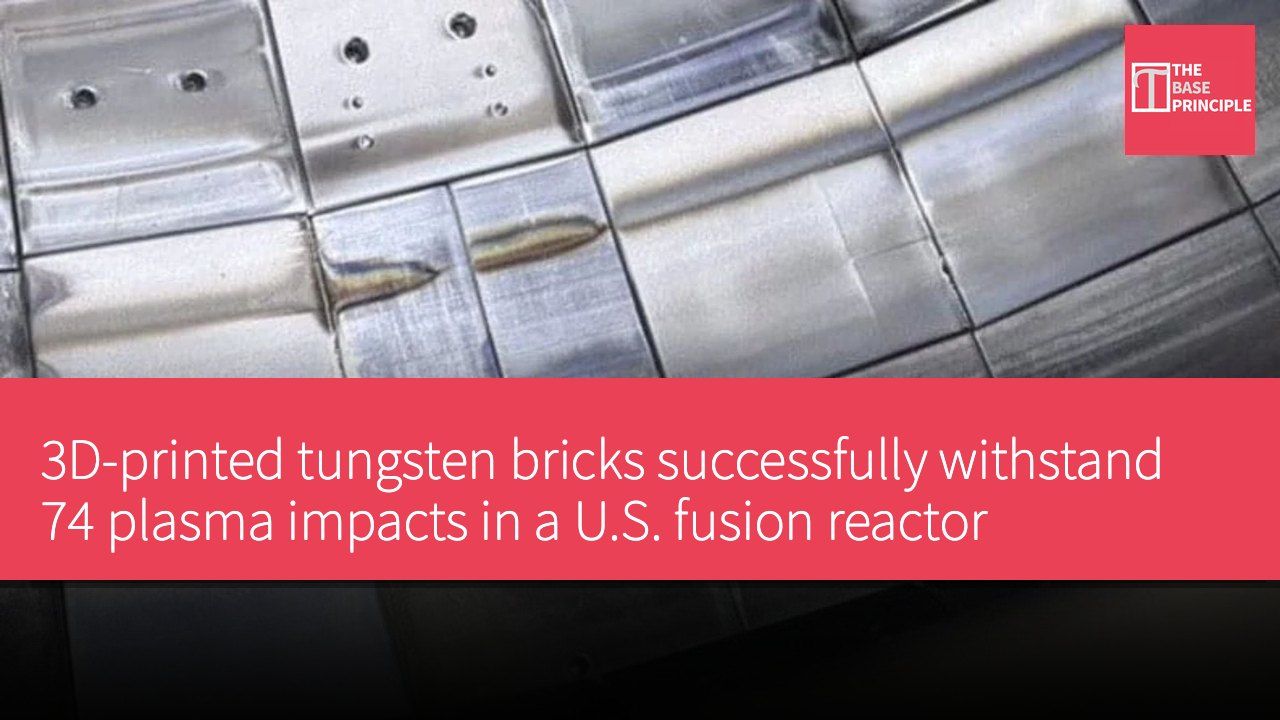
- 3D-printed tungsten bricks successfully endured 74 plasma impacts in a fusion reactor.
- Tungsten's melting point is higher than all metals, making it the preferred material for future fusion power plants.
- Researchers used electron beam powder bed fusion technology to overcome tungsten's brittleness issues.
- This successful test eliminated a critical bottleneck for commercial fusion energy.
Full-sized 3D-printed tungsten bricks remained intact after enduring extreme heat tests within a major fusion test reactor. These protective components withstood 74 direct plasma releases at the DIII-D National Fusion Facility in San Diego. During the tests, the tungsten bricks faced three days of intense particle bombardment in the machine's exhaust area, known as the divertor. In high-power operation, the tungsten bricks experienced approximately four minutes of direct plasma exposure. They even survived an accidental fire test, during which adjacent traditional bricks melted and sprayed liquid metal onto them.
These printed surfaces remained robust, demonstrating that the material can withstand heat fluxes higher than those at the center of the sun and particle bombardment driven by plasma.
Tungsten is the preferred material for future fusion power plants, such as ITER. With a melting point of 3,422°C (6,191°F), it is the highest among all metals, more than twice that of steel. Additionally, tungsten's density is quite high, comparable to pure gold. However, tungsten has long puzzled engineers. Below 600°C (1,112°F), the metal becomes brittle and can shatter under physical stress like glass. "However, most attempts to 3D print tungsten have used lasers as the printing heat source, resulting in porous and cracked outcomes," the team stated.
Electron Beam Technology Overcomes Tungsten Brittleness
To overcome this challenge, researchers turned to electron beam powder bed fusion (EB-PBF) technology. This method uses a high-speed electron beam to melt tungsten powder layer by layer, conducted in a vacuum chamber. The electron beam rapidly scans the powder bed, keeping the surrounding metal consistently above 1,400°C (2,552°F) throughout the manufacturing process. By maintaining a high-temperature environment, the system prevents cracking due to thermal shock and brittleness caused by cooling during production. Although researchers demonstrated the concept on small coin-sized samples in 2025, building components suitable for reactors requires industrial-scale expansion.
The final tungsten bricks needed to be approximately 140 millimeters in diameter and 20 millimeters thick. A collaborative team from North Carolina State University, Oak Ridge National Laboratory (ORNL), and Japanese precision manufacturer JEOL Ltd completed this leap in just eight months. JEOL produced the full-sized tungsten bricks on its large-format printer in Akishima, Japan, while ORNL provided expertise in fusion materials and project funding.
After the tungsten bricks were printed, they were shipped to North Carolina State University for post-processing. Engineers shaped the installation fixtures using electrical discharge machining, a wire-cutting method that applies no mechanical stress. Subsequently, a computer-controlled grinding bed removed about 250 microns from the surface, creating a mirror finish designed for the divertor's curved surface. These tungsten bricks were mounted on a copper alloy base and bolted in place for testing within the reactor.
Significance of the Successful Test
Scientists state that this successful test has eliminated a critical bottleneck on the path to commercial fusion energy. By demonstrating that large-scale additive manufacturing can produce solid, crack-free tungsten components, the team shows that advanced 3D printing is no longer merely experimental curiosity but a viable factory method for constructing the next generation of clean fusion reactors. "Validating new materials and manufacturing methods requires fusion-relevant data," said Dr. Florian Laggner, assistant professor of nuclear engineering and plasma physicist at North Carolina State University. "By exposing additively manufactured tungsten in DIII-D, we are generating data on survivability and erosion."
Impact of 3D Printing Technology on Fusion
This research demonstrates the potential application of 3D printing technology in fusion reactors. Tungsten, as a high-melting-point material, has long posed brittleness issues for engineers in high-temperature environments. Through electron beam powder bed fusion technology, researchers successfully produced robust tungsten components, enhancing material durability and providing viable solutions for future fusion power plants. This successful test marks a significant step toward commercial fusion energy and paves the way for the future of clean energy.