
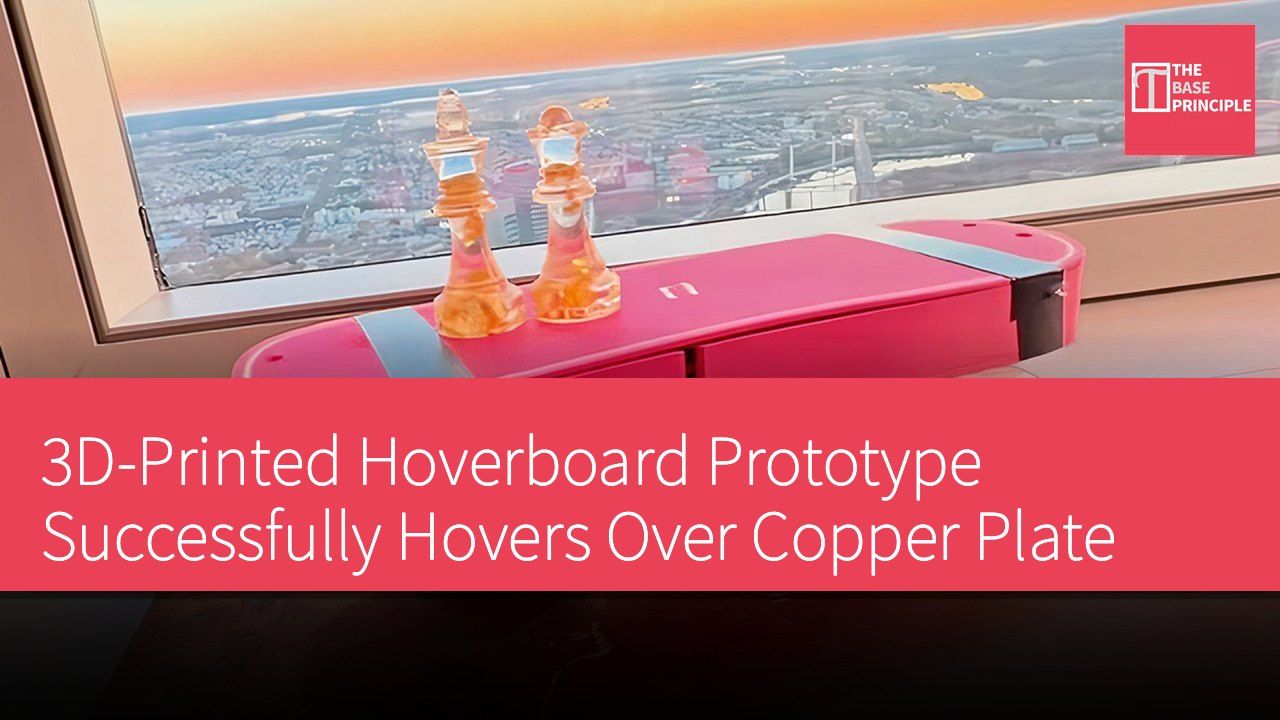
- Jack Rogers successfully created a mini hoverboard prototype.
- The hoverboard hovers over a copper plate without the need for wheels or air cushions.
- The design utilizes rotating rotors and specifically arranged magnets to enhance performance.
- Rogers plans to build a full-sized rideable hoverboard, the HALO-1, in the future.
Fans of "Back to the Future II" have long awaited the chance to ride the hoverboard piloted by Marty McFly. However, no one knows when this technology will truly hit the market. A decade ago, the situation began to change with multiple attempts to develop the technology. Although no commercially viable hoverboards have emerged to date, enthusiasts continue to push the concept forward. Recently, Jack Rogers attempted to create a palm-sized hoverboard using 3D-printed materials, magnets, brushless motors, and some small items he found in his garage.
After several weeks of effort, he built a mini hoverboard, describing it as a functional prototype that hovers on a thick copper plate, completely unrestricted, without the need for wheels or air cushions.
Hoverboard Design and Technical Details
The final design includes two rotors spinning in opposite directions, an electronic speed controller (ESP2), a converter to reduce voltage, and two batteries housed within a soft pink shell made from Polymaker material. To maximize performance, Rogers also specifically printed the rotors to accommodate a ring of twelve N52 neodymium magnets arranged in a Halbach configuration. He chose this specific arrangement to ensure a strong magnetic field directed downward while maintaining a weak magnetic field above. However, achieving this unrestricted battery-powered version was the result of multiple adjustments and tests.
In early tests, he initially started with a single motor, attempting to lift the lightweight frame off the ground. However, due to the effects of torque, the setup with multiple exposed wires was quite unstable, resulting in wobbling and twisting.
To address the twisting issue, he added a second motor. Initially, the device continued to flip over until he corrected the chaotic wiring. However, another challenge arose as the magnets kept flying outward due to strong centrifugal force. By reducing the number of magnets per motor from sixteen to twelve, he decreased the outward force by about 40% while maintaining the same speed. After resolving these issues, Rogers conducted a final redesign. He removed the dead battery that had been added for early chassis balance and placed the active 3S battery pack between the two motors.
Ultimately, this compact little hoverboard is now able to glide independently on the copper plate.
Future Plans and Development Directions
This unrestricted flight was achieved using a battery pack capable of providing 22.2 volts when activated. However, Rogers demonstrated that the device is still not stable enough and requires external assistance to maintain balance. To better understand the lift generated by the design, he also installed a sensor on the device and used simulations for calculations. According to his estimates, a magnet weighing about 3.84 grams exerts approximately 61 Newtons of force at 8,000 rpm, while a complete rotor generates an astonishing value of up to 941 grams of force at 3,000 rpm, with a gap of 5 millimeters.
However, he is reluctant to rely entirely on these simulation-based statistics, as they come from a device that vibrates violently while hovering. Despite these limitations, Rogers believes there is still room for development in this concept. Looking ahead, he stated in his YouTube video that he plans to build a full-sized rideable hoverboard, the HALO-1, which will need to operate on a conductive surface. However, before pursuing this vision, he will first experiment with a pocket-sized fingerboard toy.
Challenges and Prospects of Hoverboard Technology
Hoverboard technology has long been a dream for science fiction fans, but realizing this technology faces multiple challenges. Rogers' prototype demonstrates how to innovate using existing materials and technologies, although stability issues still need to be overcome. This process involves not only mechanical design but also a deep understanding of physical principles. Future developments could lead to larger-scale applications, particularly in transportation and entertainment, attracting more innovators to explore this field.